Route Optimization for Rural Market Expansion in Kenya: A Complete Guide for FMCG Brands
Optimize FMCG distribution in Kenya with route optimization software that improves outlet coverage, lowers delivery costs, and enhances field sales productivity.

.avif)
Kenya's FMCG market is moving fast, and the brands that win won't be those with the biggest marketing budgets. They'll be the ones that crack last-mile distribution in the heartland: the upcountry towns, sub-counties, and rural dukas that sit beyond the reach of Nairobi's well-trodden trade lanes.
The problem? Getting there consistently, profitably, and at scale is harder than most sales directors want to admit. Unpaved murram roads, sprawling geographies, and sales reps navigating beats by memory, it's a system built on guesswork, not strategy. That's exactly the gap that route optimization software was designed to close.
Why FMCG Expansion in Kenya Demands a Shift in Logistics
Kenya's consumer opportunity is undeniable. According to the World Bank, nearly 70% of Kenya's population, approximately 39 million people, lives in rural areas as of 2024. These aren't consumers waiting to be discovered; they're active FMCG buyers already purchasing through informal duka networks, weekly market days (soko), and mobile traders.
Consumer confidence is returning. Purchasing power is recovering. The opportunity window is open. And yet, the distribution infrastructure hasn't kept pace. For FMCG brands trying to maintain consistent van sales or distributor coverage in counties like Kisii, Kitui, Kakamega, or Turkana, this is not a minor operational headache. It's a structural barrier.
Meanwhile, the informal trade sector remains the backbone of Kenya's retail economy. 70% of all retail FMCG sales in Kenya still flow through informal channels, dukas, kiosks, and open-air market stalls, not supermarkets (Frontline Research Group, 2023). For brands without a structured, technology-enabled approach to reaching these outlets, rural expansion remains a promise deferred.
The solution isn't more sales reps or more trucks. It's smarter route planning software that turns geographic complexity into a competitive advantage.
What is Route Optimization?
Route optimization is the process of algorithmically determining the most efficient sequence and path for field sales teams or delivery vehicles to visit outlets, accounting for distance, time windows, outlet priority, traffic patterns, and vehicle capacity.
In practice, it replaces the mental map in a field sales executive (FSE)'s head with a data-driven beat plan that is dynamically updated, measurable, and repeatable.
Major Distribution Challenges Solved by Route Optimization
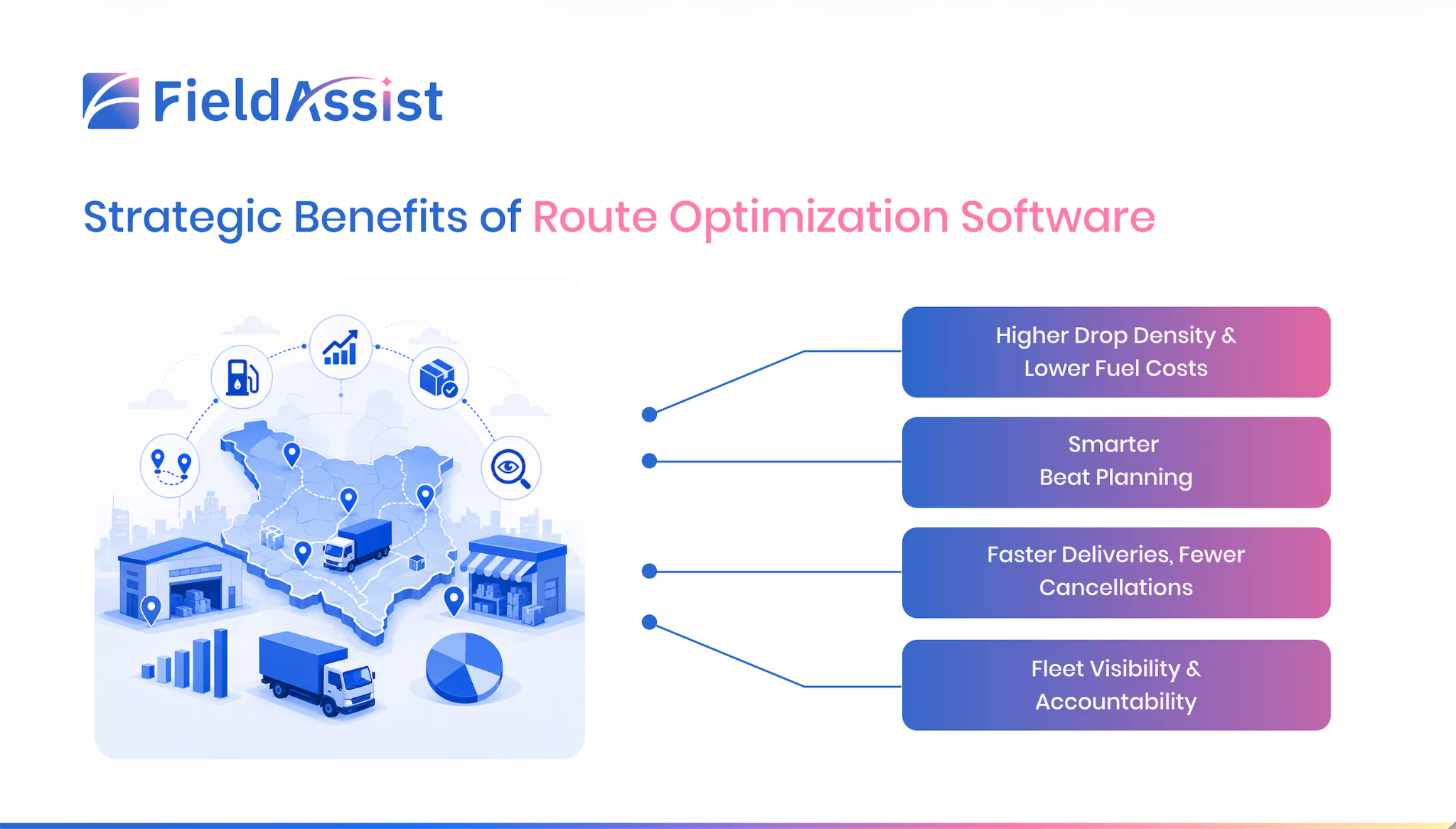
Strategic Benefits of Route Optimization Software for FMCG Distributors in Kenya
For FMCG brands operating across Kenya's 47 counties, the ROI of route optimization software is both immediate and compounding. From fuel savings on dusty murram roads to measurable improvements in outlet coverage, here's how it transforms field execution:
1. Higher Drop Density & Lower Fuel Costs
Every kilometer a van travels without making a productive stop is margin erosion. Delivery route planning software clusters outlets by geography and call frequency, ensuring reps follow a logical sequence rather than criss-crossing territories. The result: more drops per trip, lower fuel consumption, and predictable cost-per-call metrics, especially critical in remote areas where fuel costs are higher, and road conditions are slower.
For a distributor running 10–15 vans across a county like Nakuru or Kisumu, even a 15% improvement in drop density can translate to significant savings on fuel and vehicle wear annually.
2. smarter Beat Planning
Effective beat planning software in Kenya goes beyond scheduling. It factors in outlet purchase history, call frequency norms, market day cycles (soko days), and seasonal accessibility. A well-designed beat ensures your FSE isn't visiting a high-potential outlet once a month when it needs weekly service, and isn't wasting time on low-value calls that drain productivity.
Beat planning software in Kenya also allows brands to stratify outlets by tier, A, B, and C retailers, and allocate call frequency accordingly. High-value dukas and superettes get more face time; lower-potential outlets get structured periodic visits rather than being ignored or over-serviced.
3. Faster Deliveries, Fewer Cancellations
Rural Kenya's informal trade runs on reliability. A duka owner in Eldoret or Kericho who can count on your van arriving every Tuesday builds their stock planning around your brand. Inconsistent delivery schedules, driven by poor route planning, erode trust and invite competitors in.
Delivery route planning software enables time-window management, your rep arrives within a committed window, reducing waiting time for traders and improving on-time delivery rates. Fewer canceled orders. Better fill rates. Stronger trade relationships.
4. Fleet Visibility & Accountability
One of the most persistent challenges in rural Kenya distribution is ghost calls, reps marking outlet visits that never happened. With route optimization software integrated with GPS tracking, managers get live fleet visibility: where each van is, which outlets have been visited, and how long was spent at each stop.
This isn't about policing sales reps. It's about giving distributors the accountability infrastructure to coach better, plan smarter, and identify productive versus unproductive territories with confidence.
Core Features to Look For in the Best Route Optimization Software in Kenya
Not all route optimization software is built for the realities of the Kenyan market. Here's what separates a genuinely effective solution from a tool designed for a market with paved highways and reliable 4G:
- Offline Functionality for Remote Areas
The signal is patchy in upcountry Kenya. Any delivery route planner that requires constant internet connectivity will fail the moment your rep drives into Marsabit or parts of West Pokot. The best route optimization software in Kenya must have robust offline capability, syncing data when connectivity is available, while keeping reps fully functional in the field when it isn't.
- AI-Powered Predictive Routing
Static route plans get stale. AI-powered route optimization software in Kenya learns from historical visit data, seasonal patterns, and outlet performance to dynamically reorder beats and flag when a new cluster of outlets justifies a new route. This is the difference between software that automates yesterday's plan and software that builds tomorrow's strategy.
- SFA & ERP Integration
Route optimization software for FMCG distributors in Kenya must connect seamlessly with your Sales Force Automation (SFA) platform and, where applicable, your ERP or Distribution Management System (DMS). Without integration, you create data siloes, reps are optimized in one system, orders are processed in another, and management sees neither in real time.
Look for solutions where route execution and order capture happen in the same workflow, reducing app-switching, improving data accuracy, and giving managers a unified view of field performance.
- Geofencing & Address Mapping
Kenya's rural outlets don't have formal addresses. A duka in Mwingi or a hardware in Homa Bay is identified by a local landmark or a GPS pin, not a street address. The best route optimization software in Kenya must support geofencing and custom location pinning, allowing reps to capture and reuse outlet coordinates accurately. Geofencing also enables auto-check-in/check-out, removing the manual overhead of logging visits and improving the reliability of coverage data.
How FieldAssist Empowers FMCG Brands to Conquer Kenya's Rural Markets?
FieldAssist is built for FMCG brands operating in complex, high-velocity markets, and Kenya's distribution landscape. Our approach is to embed intelligent route optimization into the full field sales and distribution workflow, so every beat and every outlet interaction is connected, visible, and improvable.
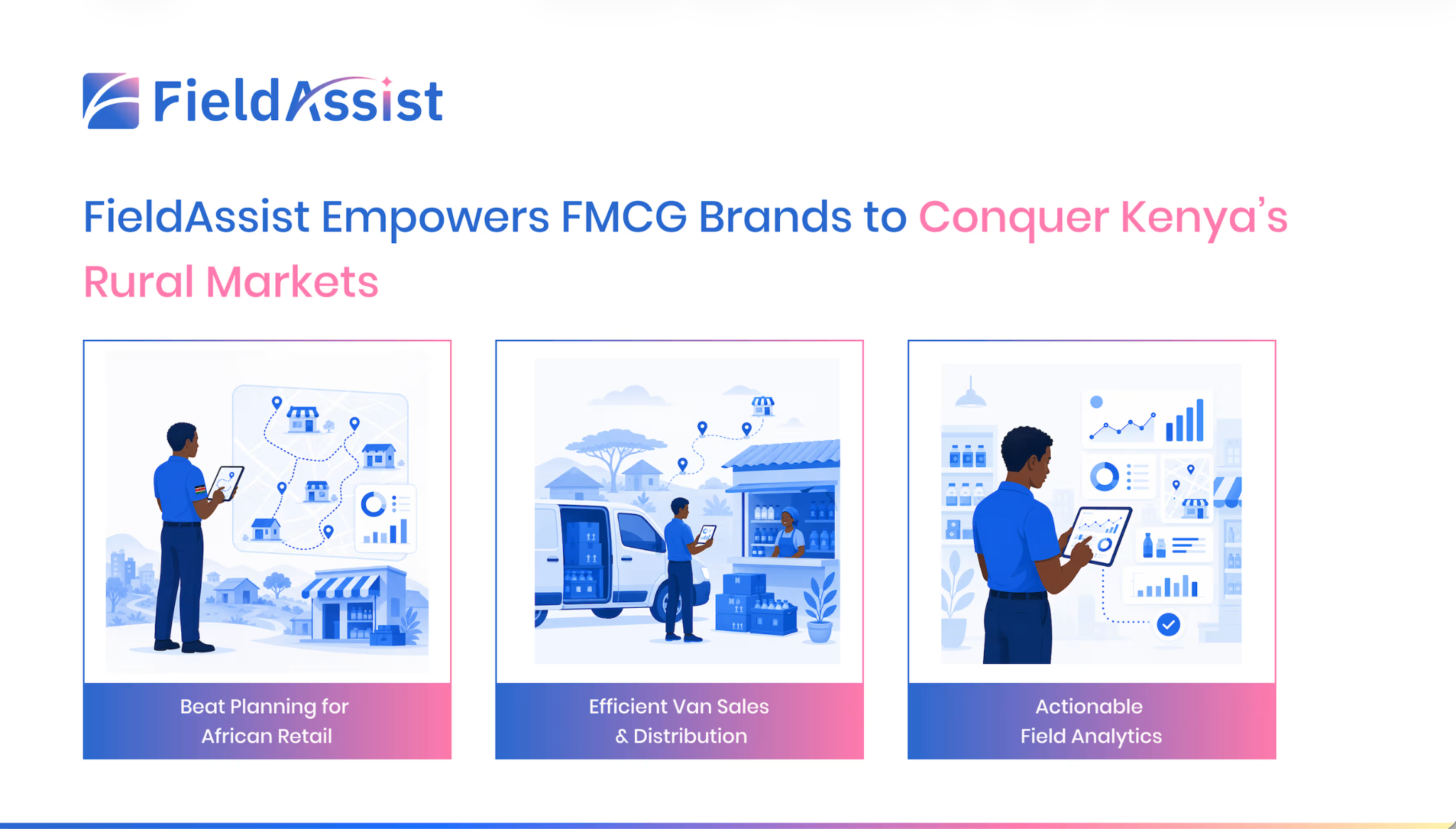
- Beat Planning for African Retail
FieldAssist's beat planning software helps FMCG brands create optimized, geography-based beat plans that account for outlet potential, market day patterns, and local terrain. Reps receive clear daily routes, while managers gain real-time visibility into route execution and coverage.
- Efficient Van Sales & Distribution
FieldAssist's delivery route planner integrates with Van Sales Automation (VSA) to provide reps with optimized routes, outlet-wise stock allocation, and order capture in a single app. This helps brands improve van productivity, reduce stockouts, optimize inventory distribution, and increase revenue from every trip.
- Actionable Field Analytics
FieldAssist provides real-time analytics on outlet coverage, rep productivity, route adherence, and missed visits. Its AI-powered insights help managers identify high-potential outlets, coverage gaps, and growth opportunities, turning field data into actionable business decisions.
Accelerate Your Rural Growth Engine with FieldAssist
Kenya's rural FMCG opportunity is real, growing, and increasingly competitive. The brands that move first with structured, technology-enabled distribution will lock in shelf presence, trade relationships, and consumer loyalty in markets their competitors are still trying to map.
Route optimization is not a future capability to consider; it's a present-day necessity for any FMCG brand serious about growing beyond Nairobi. Whether you're a multinational scaling coverage in Rift Valley, a regional brand pushing into Coast and Nyanza, or a distributor trying to run leaner operations across difficult terrain, the right delivery route planning software changes the economics of rural distribution fundamentally.
Ready to close the last-mile execution gap? Request a Demo and see how FieldAssist's route optimization software for FMCG distributors in Kenya delivers measurable results from day one.



%20(1).avif)