Why Shelf Execution Is the Real Growth Lever in Africa’s FMCG Market?
Learn how poor shelf execution affects FMCG growth, and how retail merchandising software can be used to improve On-Shelf Availability (OSA) and Share of Shelf (SOS).

Africa’s FMCG story is often explained with big numbers: very fast population growth, more people moving to cities, a growing middle class, and many young people who want to buy and use more products. But behind these positive signs is a quiet problem that many company leaders do not pay enough attention to: which products truly reach the shops, remain available on the shelves, and are noticed and chosen by customers.
In many cases, companies operating without modern retail merchandising software lack real-time visibility into what actually happens at store level, and unable to track execution consistently across fragmented retail environments.
During a leadership discussion in East Africa, several CEOs captured this reality bluntly: “Demand is not our problem. Distribution isn’t either. The problem is that products on the shelf don’t sell the way our plan expects them to.”
Even small execution gaps can have a huge impact. A 3% improvement in on-shelf availability can lead to nearly a 1% increase in sales. While that may appear modest, at scale it represents millions of dollars in incremental revenue.
Many FMCG brands have expanded distributor networks and increased store visits, yet continue to lose share in core categories. Post-analysis consistently points to the same causes: inconsistent on-shelf availability, weak must-sell SKU execution, and poor planogram adherence across fragmented retail formats.
Thus, Africa’s FMCG growth challenge is no longer about demand creation, it is about execution at the shelf.
Africa’s FMCG Growth Paradox: High Demand, Low Shelf Availability
Across Africa, demand for fast-moving consumer goods remains strong. The growth of informal and semi-formal shops is increasing daily buying. In areas like food, personal care, and home care, customers are ready and willing to buy.
Yet brand growth is failing to keep pace with this demand.
The problem is not mainly price or distribution. In many countries, brands already reach most shops through distributors. The real problem starts after the product enters the shop.
- Products are often not available on the shelf.
- Important items are missing even when stock exists in the system.
- Shelf space is given to faster-selling or higher-profit competitors.
- The quality of sales execution is very different from shop to shop and from salesperson to salesperson.
This growing gap between what customers want and what is actually on the shelf has become one of the biggest, and least noticed, barriers to FMCG growth in Africa.
The Cost of Poor Shelf Execution
Poor shelf execution directly affects sales by reducing product visibility and interrupting the shopper’s purchase journey. Although the effect of poor shelf execution rarely shows up as a single breakdown, but they accumulate quietly across thousands of stores, creating the illusion of “market softness” when the real issue is execution leakage.
CXO Insight: Problems like not following the agreed shelf plan, too few products on the shelf, poor product visibility, or damaged/expired stock do not show up as one big failure. Instead, they quietly add up across thousands of shops. Over time, this makes the market look weak, even though the real problem is poor shelf execution.
On-Shelf Availability (OSA) and Share of Shelf (SOS): The Key Driver for Brand Success
On-Shelf Availability (OSA) indicates where the brand is present, and Share of Shelf (SOS) indicates how dominant its presence is on the shelf. When either breaks down, brand equity and marketing investment are neutralized at the point of purchase.
This is why OSA and SOS are no longer operational KPIs. They are growth control levers.
Think about this for a second. In Africa’s modern-traditional hybrid retail environment, the share of shelf is the battlefield. The buying environment is fast, habitual, and increasingly substitution-driven. Consumers:
- Rarely ask retailers for a specific brand
- Choose from what is available, visible, and familiar in the moment
- Switch brands easily when favorite products are missing
Thus, OSA and SOS become critical for in-store retail execution because when either breaks down, losses compound across the value chain::
- Brand recall weakens at the point of habit formation
- Lost primary sales due to stock misalignment
- Secondary sales volatility due to erratic replenishment
- Inefficient sales routes and increased repeat visits
- Forecasting accuracy deteriorates across the supply chain
- Reduced ROI on promotions and trade schemes
- Margins dilute due to ineffective promotions and markdowns
Africa FMCG Reality: Why Shelf Execution Breaks Down at Scale?
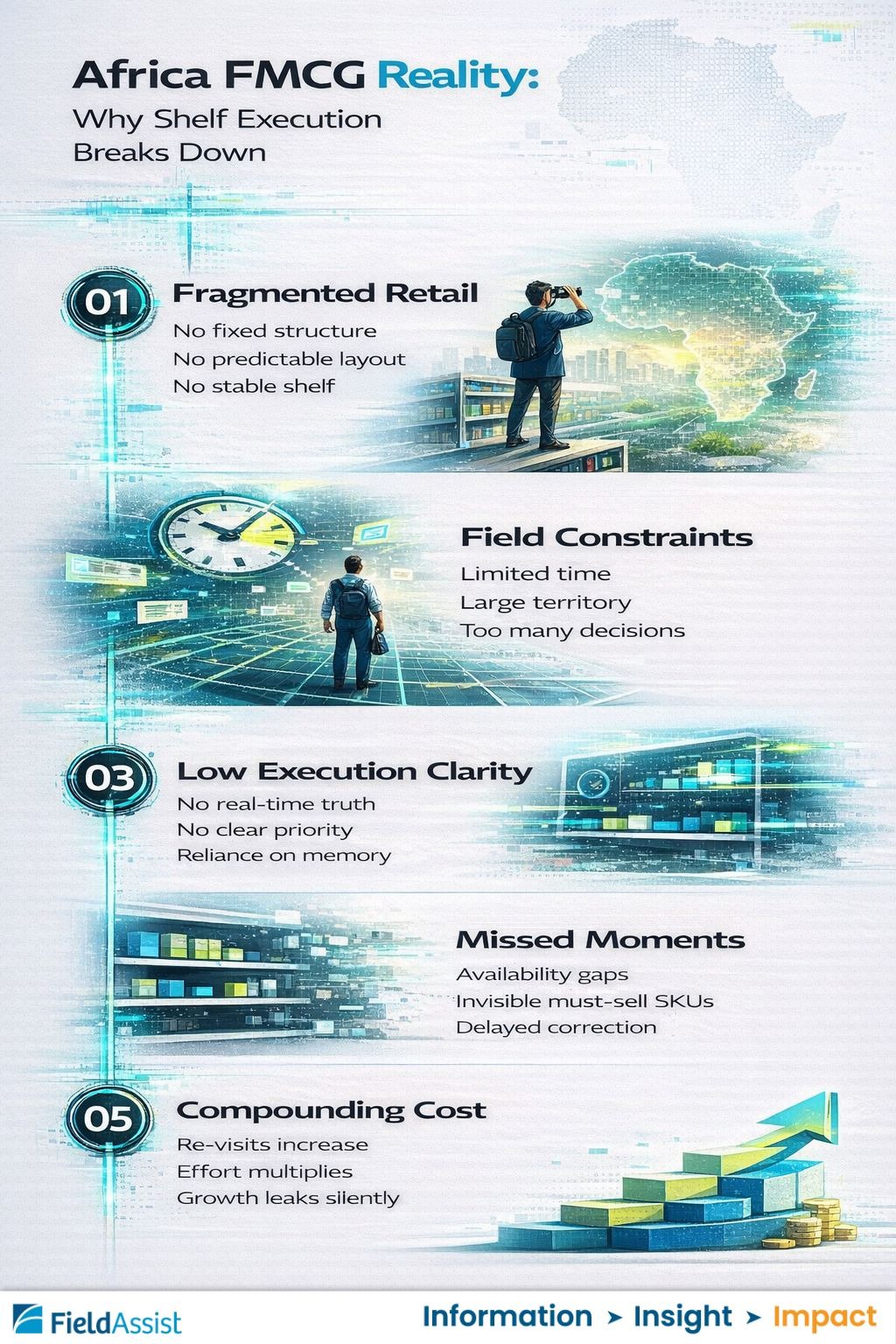
Shelf execution challenges in Africa stem from three interconnected realities: (a) A highly fragmented retail universe, (b) Field teams operating under severe execution constraints, and (c) Limited use of intelligence-led tools that translate strategy into in-store action.
Unless these are addressed together, execution remains inconsistent—regardless of investment in people or distribution.
1. Fragmented Retail Environment:
Africa’s FMCG retail landscape is fundamentally different from modern trade-led markets. Execution breaks down because the shelf itself is unstable. Key realities include:
- Dominance of informal and semi-formal outlets
- Retailer-led shelf decisions
- High variability in store size and capacity
- Frequent SKU substitution and assortment drift
- Limited data visibility beyond order history
2. Field Force Challenges
Sales teams are expected to “execute perfectly” in an environment that actively resists consistency. Execution breaks down not due to lack of effort, but due to operating constraints:
- Large territories and compressed visit time
- Manual or memory-based shelf checks
- Incentives skewed toward volume, not execution quality
- Limited ability to act on shelf gaps in real time
- Execution fatigue over time
3. Absence of AI-Led Execution Intelligence
The most critical, and least acknowledged, gap is technological. Most African FMCG operations still rely on transactional systems that report what happened, not intelligence systems that influence what should happen next. Execution breaks down because:
- Shelf visibility is not real-time
- No prioritization of execution actions at store or SKU level
- Limited conversion of data into field guidance
- High dependency on manual supervision
- Missed opportunity to nudge behavior at the point of action
Impact on Key Metrics: How Shelf Execution Shapes Revenue Outcomes
Shelf execution failures rarely appear as a single operational issue. Instead, they surface as volatility across core commercial metrics - sales growth, forecast accuracy, trade ROI, and market share. Four execution metrics sit at the center of this impact:
- On-Shelf Availability (OSA)
- Must-Sell SKU execution
- Share of Shelf (SOS)
- Planogram Compliance
Together, they determine whether market demand converts into predictable revenue or leaks silently across the system.
Role of Smart Merchandising in Bringing Systematic Shelf Execution Without Re-Visits
The current operating model of identifying shelf gaps is expensive, exhausting, and slow.
Think about it for a second, sales teams visit stores, identify issues, place orders, and move on. Problems discovered later, stock-outs, missing must-sell SKUs, poor visibility, trigger follow-up visits. Clearly, this operative model cannot keep up the pace of Africa's growing FMCG sector.
Execution-focused retail merchandising software changes this by bringing intelligence into the moment of the visit:
- Interpret store-level conditions
- Highlight OSA and OOS risks.
- Flags missing must-sell SKUs.
- Prioritize actions based on revenue impact
- Nudge the reps toward the right decision
This is where AI-led execution intelligence becomes a game-changer.
The result is fewer missed steps, fewer errors, and fewer follow-ups. Additionally, reducing re-visits has a compounding effect on the business, including higher productive selling time, Lower cost-to-serve, more predictable execution outcomes, and Improved distributor coordination. All of your orders reflect actual shelf needs.
Which AI Merchandising Software helps improve shelf execution?
Shelf execution improves only when software connects intent, inventory, and in-store reality, continuously and in real time. Some modern software you should consider investing in are:
1. Retail Intelligence & Shelf Audits: Shelf execution cannot be improved if the shelf itself is invisible to management. Retail Image recognition software, such as IRIS and Modmart help in countering OSA & OSS: by:
- Detecting missing SKUs, low facings, and planogram violations
- Highlighting execution gaps by outlet, rep, route, or region
- Separating distribution problems from execution problems
2. Analytics & Control Towers: FA Analytics Studio unifies sales, distribution, and shelf data into one control layer, and proven beneficial in:
- Flagging outlets at risk of OOS before the next visit
- Identifying systemic gaps (route design, SKU mix, distributor fill rates)
- Enabling managers to intervene early, not escalate late
3. Sales Force Automation (SFA) with Gamification: Once shelf risks are visible and priorities are clear, why not let the sales rep actually do the right things during the visit? This is where SFA combined with gamification, plays a critical role in:
- Converting shelf priorities into clear daily targets for reps
- Allowing companies to set simple, business-specific KPIs
- Showing reps their progress in real time, during the working day
Why FieldAssist Is Built for Shelf Execution in Africa’s FMCG Reality?
FieldAssist is designed for FMCG brands operating in fragmented retail environments where shelf execution, not demand, limits growth. The platform focuses on what actually improves on-ground execution - detecting OSA and OOS risks during store visits, guiding must-sell SKU focus, and enforcing practical planogram compliance in real time.
Powered by FAi, FieldAssist brings applied AI into daily field execution by interpreting shelf signals and nudging the right in-store actions without increasing supervision or re-visits.
This 3i execution model is already proven in live deployments, including with a premium dairy and food brand, where FieldAssist achieved 75–80% SKU detection accuracy, improving shelf visibility and execution consistency at scale.
If you would like to learn more about improving shelf space in Africa, contact us today.



%20(1).avif)