How AI Copilots Turn Sales Data into Daily Business Decisions?
Discover how AI sales copilots help FMCG and CPG sales leaders turn real-time sales data into faster decisions, actionable insights, and better field execution.

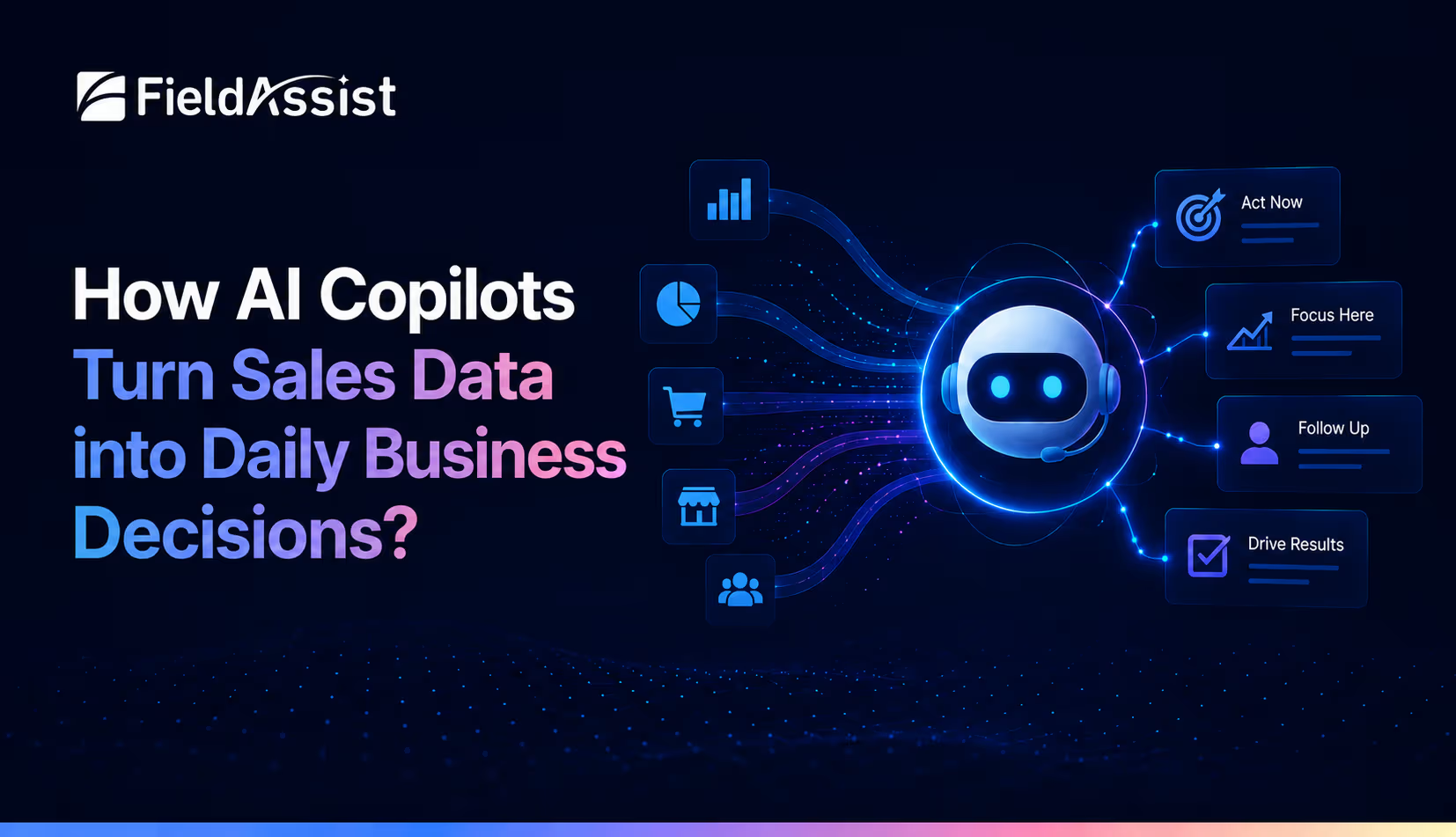
Every CPG and FMCG sales organization sits on more data than it has ever had, SKU-level sell-out, distributor stock, retailer compliance scores, and field visit logs. Yet on any given Monday morning, most sales leaders are still working off yesterday’s spreadsheet, or worse, last week’s.
The real “last mile” problem in B2B sales is all about decisions. This is where an AI sales copilot changes the equation: instead of asking humans to mine dashboards for meaning, it surfaces the meaning directly, in the flow of work, so sales leadership can act the same day the data lands.
This piece breaks down what an AI copilot for sales actually does, why traditional reporting keeps failing sales teams, and how FieldAssist’s Pulse AI Co-Pilot turns raw sales data into daily, execution-ready decisions.
What Is an AI Sales Copilot?
It is a purpose-built AI layer that sits on top of a company’s sales systems, SFA, DMS, CRM, BI, and interprets that data on a sales leader’s behalf, in natural language, on demand. It isn’t a chatbot bolted onto a dashboard, and it isn’t a static report scheduled to land in an inbox every morning.
It understands sales context, territory structures, SKU hierarchies, distributor norms, seasonal patterns, and answers the specific question a regional sales manager or CXO is actually asking, right when they’re asking it. Where a traditional BI tool tells you what happened, this layer tells you what happened, why it happened, and what to do about it, closing a gap that has defined B2B sales reporting for two decades.
Why Sales Teams Struggle to Turn Data into Action?
Sales leaders aren’t short on data. They’re short on the ability to convert it into a decision before the moment to act has passed. Four structural problems keep repeating across CPG and FMCG sales organizations.
1. Too Much Data, Too Little Context
Modern SFA and DMS platforms generate more granular data than any human team can manually review, order-level detail, SKU-wise sell-out, retailer compliance scores, route adherence. But volume without context is just noise. A regional sales manager doesn’t need forty charts; they need to know which three distributors are about to run out of a fast-moving SKU this week, and why. Most reporting stacks were built to display data, not to interpret it.
2. Delayed Insights and Slow Responses
By the time a weekly or monthly MIS report reaches a zonal head, the stockout, the competitor scheme, or the underperforming outlet it describes has already cost sales. Traditional business intelligence is retrospective by design, it tells leadership what happened last week, not what’s happening right now. Without real-time sales insights, sales teams are permanently reacting to a market that has already moved on.
3. Siloed Data Across Sales Systems
Order data lives in the DMS, field activity lives in the SFA, secondary sales and outlet coverage live in a retail execution tool, and finance numbers live somewhere else entirely. Getting one unified view of “how is this month actually going” often means exporting from four systems into a spreadsheet, a process most regional managers don’t have time for on a Tuesday morning, let alone every day.
4. The Gap Between Insights and Execution
Even when a dashboard surfaces a useful insight, say, a distributor with declining secondary sales, nothing happens next unless a person manually flags it, assigns it, and follows up. Insight without a built-in nudge to act is just another slide in a business review. This is the execution gap that keeps insights trapped in reports instead of reaching the field the same day.
How AI improves sales decision making?
This is precisely the layer where AI for sales decision making earns its place in the stack, not as a replacement for sales judgment, but as the mechanism that gets the right information in front of the right person before the window to act closes.
- Bringing Context to Every Sales Decision
Rather than presenting a raw number, an AI copilot for sales attaches context automatically, how this week’s figure compares to last month, to the same period last year, to the territory average. A sales leader isn’t just told “secondary sales are down 12%”; they’re told which outlets, which SKUs, and the likely cause, in one pass.
- Identifying Priorities in Real Time
With real-time sales insights, AI systems continuously rank what needs attention today, the distributor nearing a credit limit, the outlet that hasn’t been visited in three weeks, the SKU losing shelf share to a competitor, instead of leaving a sales leader to hunt for the signal inside a sea of routine data.
- Reducing Manual Analysis and Guesswork
Pulling numbers, building pivot tables, and reconciling three systems used to be a full day’s work before a decision could even be made. AI absorbs that manual layer entirely, so sales leaders spend their time deciding and directing the field, not assembling the evidence to decide.
- Enabling Faster Responses to Market Changes
CPG demand shifts fast, a heatwave spikes beverage sales, a competitor launches a scheme, a key account runs low on stock. A copilot built for this context flags these shifts as they happen rather than at month-end, giving sales leaders the runway to respond while the opportunity, or the risk, is still live.
How AI analyzes sales data?
An AI copilot for sales doesn’t replace the analytics stack, it sits on top of it and performs the interpretation layer that used to require a dedicated data analyst. It ingests structured data from SFA, DMS, and BI systems (orders, visits, stock, scheme redemptions), applies pattern recognition to flag anomalies and trends against historical baselines, and translates the output into plain-language answers or recommendations rather than raw tables.
Gartner projects that by 2025, 60% of B2B sales organizations will have shifted from experience- and intuition-based selling to a fully data-driven selling approach, merging sales process, applications, data, and analytics into a single operational practice.
In practice, this means the copilot can answer a question like “which distributors are likely to under-deliver this month” by cross-referencing order velocity, seasonality, and route coverage, work that would otherwise take an analyst hours to compile manually.
What are the benefits of an AI sales copilot?
Once sales data flows through a copilot instead of a static report, the payoff shows up across five areas that matter to both CXOs and the people managing territories every day.
1. Faster Decision-Making
Decisions that once waited for a weekly review now happen the same day the underlying number changes, because the interpretation step is instant instead of manual.
2. Better Visibility Across the Sales Network
Zonal, regional, and national leaders get the same real-time sales insights simultaneously, instead of each level waiting for a rolled-up report from the level below, collapsing the usual reporting lag between field and HQ.
3. Increased Sales Productivity
Sellers who partner effectively with AI tools are 3.7 times more likely to hit quota than those who don’t, according to a 2024 Gartner survey of more than 1,000 B2B sellers, a gap driven largely by how much manual, non-selling work AI absorbs.
4. Improved Forecast Accuracy
Because this layer continuously reconciles order data, stock levels, and historical patterns, forecasts stay closer to ground reality than static, spreadsheet-built projections that go stale the moment field conditions shift.
5. Higher Revenue Opportunities
McKinsey’s research on sales-growth outperformers finds that stronger use of data-driven insight alone accounts for a 2 to 5 percent lift in sales performance, on top of separate gains from agility and talent, insight-led growth compounds once the interpretation gap closes.
How can sales leaders use AI for daily decision-making?
Turning AI for sales decision making into a daily habit, rather than an occasional report, starts with a few practical shifts. Sales leaders can open the day with a copilot-generated priority list instead of a blank dashboard, the three distributors needing attention, the outlets at risk of going dark, the SKUs losing momentum, rather than deciding where to look first.
They can ask direct questions in natural language, such as which territories are behind the target this week, instead of waiting for someone to build that view. And they can push AI-flagged issues straight to field teams as tasks, rather than treating insight and execution as two separate steps owned by two separate people.
The stakes of getting this right are larger than they appear. McKinsey’s global survey on organizational decision-making found that only 20% of executives believe their organizations excel at decision-making, and 61% say the time spent on decisions is largely wasted, a gap AI is well-positioned to close, since most of that waste comes from manually assembling information rather than deciding on it.
For CPG sales organizations running thousands of outlets and dozens of distributors, that inefficiency compounds daily, which is exactly why building AI into the daily decision rhythm, not just the monthly review, matters.
How FieldAssist Pulse AI Co-Pilot Helps Sales Leaders Make Faster Decisions?
FieldAssist built Pulse AI Co-Pilot specifically for CPG and FMCG sales leaders who need an AI copilot for sales that understands retail execution, not generic sales conversations. Here’s how it operationalizes everything above.
- Unifying SFA, DMS, BI, and Retail Execution Data
Pulse pulls from FieldAssist’s SFA, DMS, and Analytics Studio in one layer, so a sales leader isn’t stitching together four exports to answer one question about territory performance.
- Asking Questions in Natural Language
Instead of navigating filters and pivot views, users ask Pulse directly, for instance, which outlets in the North zone missed their visit frequency this week, and get an answer in seconds, not a data request ticket.
- Accessing Real-Time Sales Insights Instantly
Because Pulse reads live SFA and DMS data rather than a batch-processed export, sales leaders get visibility into stock, orders, and field activity as they happen in the market, not after a nightly refresh.
- Receiving Role-Aware Recommendations
A national sales head and a territory sales officer see different priorities from the same underlying data, Pulse tailors what it surfaces to the role asking, so recommendations are relevant to what that person can actually act on.
- Turning Insights into Execution Nudges
When Pulse flags an at-risk distributor or a compliance gap, it doesn’t stop at the alert, it can push a task directly to the relevant field executive, closing the loop between noticing a problem and someone actually handling it.
- Closing the Loop Between Decisions and Field Action
Because Pulse is built on FieldAssist’s retail execution stack, a decision made on a dashboard translates into a field visit, a scheme correction, or a restock order without leaving the platform, decisions don’t stall at the handoff between office and outlet.
- Reducing Dashboard Dependency Across Teams
Bain’s 2026 survey of more than 1,000 sales and marketing executives found that organizations rewiring their commercial workflows around AI, rather than simply layering AI onto existing dashboards, see roughly double the commercial impact of those that don’t. That’s the shift Pulse is built for, less time spent parsing dashboards, more time spent acting on what the AI copilot for sales has already surfaced.
Learn more about FieldAssist’s Pulse AI Co-Pilot at fieldassist.com/fai-sales-copilot.
Conclusion: Turning Sales Data into Daily Business Decisions with AI Copilots
CPG and FMCG sales organizations don’t have a data problem anymore, they have an interpretation and execution problem. Reports still arrive too late, too fragmented, and too disconnected from what the field can actually do about them.
An AI sales copilot closes that gap by turning sales data into a daily operating rhythm instead of a monthly review: surfacing what matters, explaining why it matters, and pushing the resulting action to the people who can execute it.
For sales leaders trying to keep pace with faster-moving markets and thinner margins, that shift, from AI for sales decision making as a concept to real-time, execution-ready insight as a daily habit, is what separates organizations that react to the last mile from those that manage it.
Explore how FieldAssist’s Pulse AI Co-Pilot brings this to life at. Get in touch




.avif)