What Is General Trade? A Complete Guide for FMCG Businesses
General trade in FMCG, its importance, key challenges, and strategies to improve retail coverage, distributor coordination, and sales performance.

What is General Trade in FMCG?
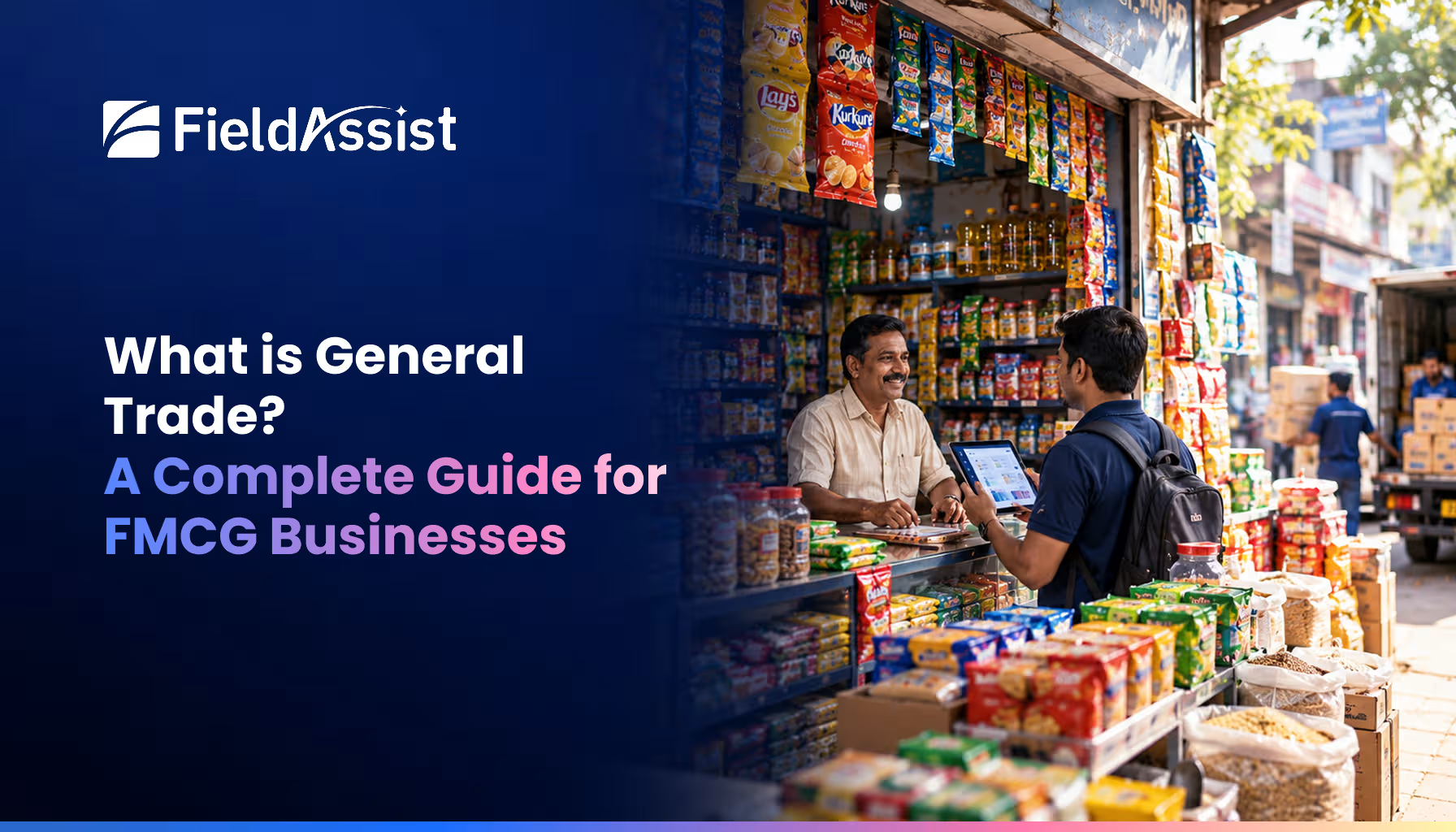
General trade is the traditional retail channel where FMCG brands sell through independent, owner-operated outlets instead of organized chains. Think kirana stores, provision stores, chemists, paan-beedi kiosks and wholesale counters. In Africa they are dukas and spazas; in Southeast Asia, warungs and sari-sari stores. The names change, the model doesn't: a small shelf, a shopkeeper who decides what gets stocked, and a salesperson who has to show up to earn the order.
For most brands in emerging markets, general trade in FMCG remains the backbone of distribution. NielsenIQ's Q2 2026 India snapshot puts e-commerce at 7% of FMCG sales nationally. That is a real shift, but it sits alongside a physical outlet network that still has to be visited, sold to and replenished.
Unlike modern retail, general trade sales are not won through a head-office listing. They are won outlet by outlet, beat by beat. That is where the "last mile" execution gap lives, and it is the gap FieldAssist was built to close.
How Does General Trade Work in FMCG?
The flow is layered. A manufacturer ships to a super stockist or C&F agent, who supplies distributors. Distributors serve wholesalers and retailers directly, and in some markets sub-distributors or van-sales operators fill the gaps. At the end of the chain, a distributor salesman or company rep visits outlets on a fixed beat, usually weekly or fortnightly, to take orders, collect payments, check stock and explain schemes.
Three features define the model. First, buying is relationship-led: retailers order on trust, credit terms and scheme value. Second, visibility is thin: the brand sees primary sales to the distributor, but secondary sales to the outlet often arrive weeks later. Third, execution depends on people: coverage, call quality and merchandising all come down to what a rep does in a few minutes at the counter.
That is how general trade works on paper. In practice, it works only as well as the data behind each beat plan.
Why Is General Trade Important for FMCG Businesses?
Modern retail and quick commerce are growing, but no serious FMCG brand can opt out of this channel. Here is why.
1. Expanding Market Reach Across Urban and Rural Areas
Supermarkets cluster in metros. Small outlets exist in every neighborhood, small town and village. For a brand pushing into Tier 2-4 towns or rural districts, this channel is often the only way to put the product within walking distance of the shopper.
2. Building Strong Retailer Relationships
A shopkeeper who trusts your rep gives your SKU eye-level space, recommends it to walk-in customers and pays on time. These relationships compound, and a competitor or an app cannot copy them quickly.
3. Improving Product Availability and Distribution
Availability is where sales are won or lost. IHL Group's 2026 Inventory Distortion Study puts the global cost of out-of-stocks and overstocks at $1.7 trillion, or 6.2% of retail sales. In general trade, stock sits across thousands of independent outlets with no scanner data, so these gaps are harder to see.
4. Supporting Sales Growth and Market Penetration
Numeric distribution, the number of outlets carrying your product, is one of the most direct levers on volume. Every outlet that stocks and reorders your SKU adds repeat demand, and for new launches this is where trial happens at scale.
5. Reaching Diverse Consumer Segments
Small outlets serve daily-wage earners buying single-serve sachets, households topping up on credit and price-sensitive shoppers who buy small and buy often. Pack sizes, price points and schemes can be tuned to neighborhood demand, which a national chain's single planogram rarely allows.
What Are the Key Challenges of General Trade in FMCG?
The fragmentation that makes the channel valuable also makes it hard to run.
- Managing a Large and Fragmented Retail Network
A mid-size brand may serve hundreds of thousands of outlets, each ordering a modest amount. No two have the same potential. Treating them alike wastes calls on low-value stores and starves the high-potential ones.
- Maintaining Consistent Outlet Coverage
Beat plans built on spreadsheets drift. Reps skip distant outlets, territories overlap and new outlets never get added. Coverage looks complete in a report but has holes on the ground.
- Limited Visibility into Secondary Sales
When secondary data comes from distributor claims and monthly reports, leadership decides on last month's reality. Scheme performance is hard to judge, and slow-moving SKUs hide until the stock ages.
- Managing Stock Availability and Stockouts
Outlet-level stock depends on a rep's eyes and memory. Without structured stock capture or distributor stock visibility, stockouts surface only when a shopkeeper complains or a competitor fills the gap.
- Ensuring Trade Scheme Compliance
Schemes drive volume only if the retailer knows about them and receives the benefit. Disputed claims, delayed credit notes and uncommunicated offers erode trust and eat margin.
- Monitoring Field Sales Team Performance
Managers can see targets and achievements, but not how the day was spent: calls made, time in outlet, lines per call, strike rate. Without that, coaching becomes guesswork.
- Handling Manual Processes and Data Gaps
Paper order books, WhatsApp photos and Excel trackers add delay and error at every handoff, and data quietly disappears along the way. Reps lose selling time to reporting.
General Trade vs Modern Trade: Key Differences
Both channels matter, but they run on different operating models.
Modern trade rewards negotiation at the head office. General trade rewards execution at the outlet. A modern-trade playbook applied here rarely works.
How Can FMCG Businesses Improve General Trade Sales?
1. Optimize Sales Routes and Beat Plans
Build beats around outlet potential, geography and visit frequency, not historic habit. Cluster outlets, sequence them to cut travel time and rebalance workloads when territories change. Less time on the road means more productive calls per day.
2. Improve Retail Outlet Coverage
Map every outlet in your universe, including the ones you don't serve. Whitespace analysis shows where potential exists but coverage doesn't, so you add outlets deliberately. Classify outlets as A, B or C to set visit frequency.
3. Strengthen Distributor and Retailer Coordination
Distributor stock, fill rates and claim cycles decide what reaches the shelf. Share demand signals, track secondary sales regularly and make claim settlement predictable. A retailer's confidence in your brand is often confidence in your distributor's service.
4. Improve Order Booking and Stock Availability
Capture orders in the outlet, in real time, with live stock and scheme visibility. A Gartner survey found that sales organizations giving sellers AI-enabled next best actions are 2.6x more likely to achieve commercial growth. In general trade, that action can be simple: "this outlet is missing two SKUs that similar outlets sell well."
5. Track Sales Performance and Execution Metrics
Measure what predicts sales: productive calls, strike rate, lines per call, numeric distribution, on-shelf availability and scheme participation. Review them weekly by rep and territory, and coach to the gaps. Teams that tighten this loop lift general trade sales without adding headcount.
How FieldAssist Helps FMCG Brands Manage General Trade?
FieldAssist is a global SaaS platform for AI-driven retail execution and sales force automation. Field Assist general trade solutions start from one premise: the last mile is where strategy either converts into sales or leaks away. The platform connects the field, the distributor and head office on one data layer. Brands across Asia, Africa and the Middle East use it where fragmented outlet networks make field execution the difference between a plan and a sale. Here is what Field Assist general trade execution looks like in practice:
- Sales Force Automation (SFA): digital beat plans, in-outlet order capture, attendance, visit tracking and performance dashboards for every rep and manager.
- Distributor Management System (DMS): primary and secondary sales, stock and claims visibility across your distributor network.
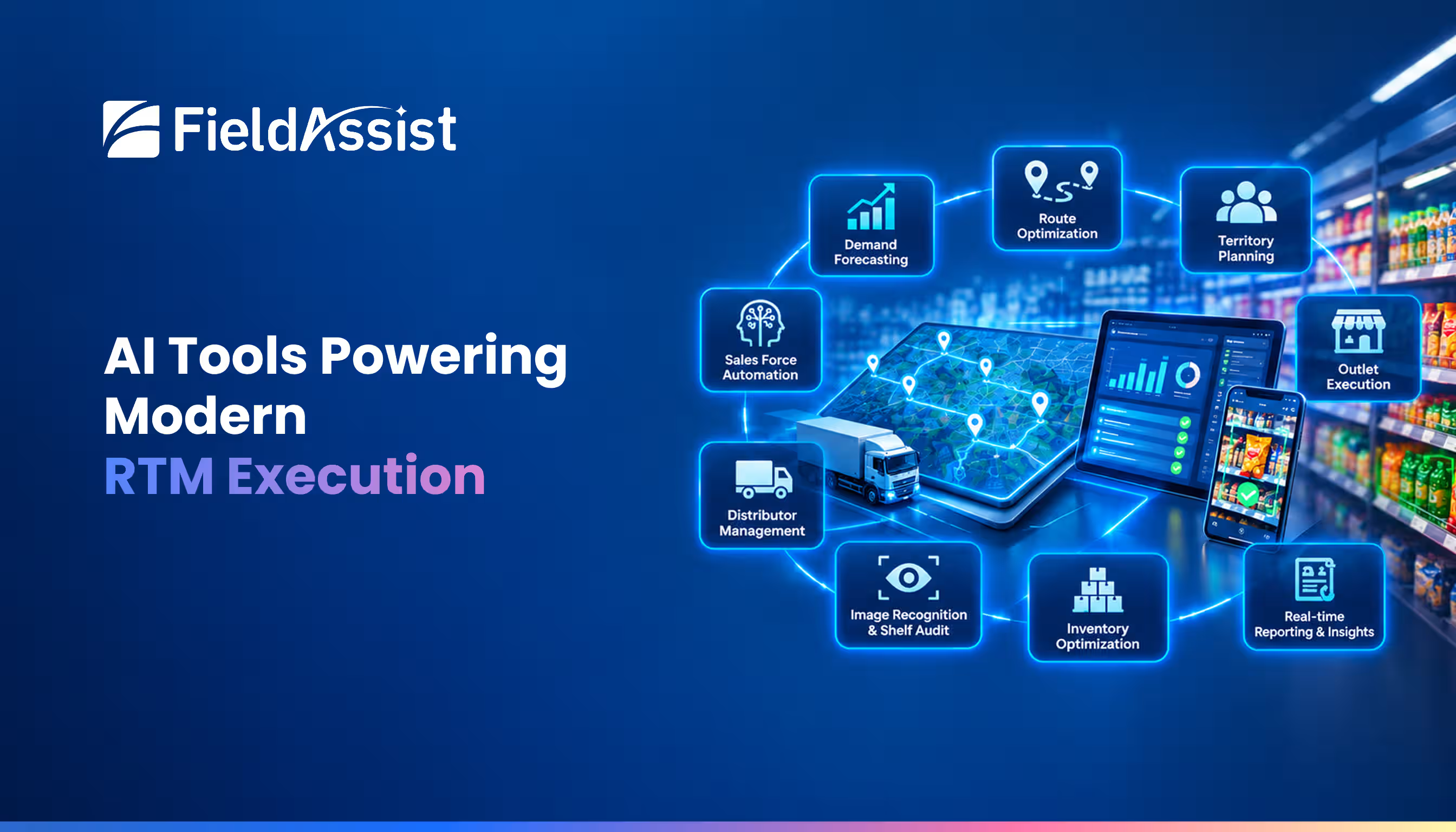
- Route optimization and Micromarket: AI-led beat planning and location intelligence to find whitespace and prioritize outlets.
- IRIS and Perfect Store: image recognition that checks shelf execution, planogram compliance and share of shelf from a photo.
- Product Recommendations: suggested orders that help reps sell the right assortment, not just refill what's already there. Explore the full FAi suite.
Field Assist general trade tools don't replace the rep or the retailer relationship. They give both better information, so every visit counts. Learn more at fieldassist.com.
Best Practices for Building an Effective General Trade Strategy
- Segment Retail Outlets by Potential
Classify outlets by purchase history, size, location, footfall and category fit. Set visit frequency, assortment and scheme eligibility by segment. A top-tier outlet may get weekly visits with the full range; a long-tail outlet may be better served through distributor telesales or a retailer ordering app.
- Develop a Strong Route-to-Market Strategy
Decide which outlets are served direct, which through wholesalers or sub-distributors, and where van sales or digital ordering make economic sense. Revisit the design every year, because outlet density, roads and shopper behavior change.
- Align Sales Targets with Market Opportunities
Targets set as last year plus 10% punish reps in saturated territories and reward those in easy ones. Use outlet universe, whitespace and category potential to build targets that reflect where general trade sales growth actually is.
- Improve Retailer Engagement and Relationship Management
Retailers respond to reliable service: on-time delivery, quick claim settlement, clear schemes and a rep who shows up on the promised day. Retailer apps and loyalty programs build the reorder habit.
- Use Data-Driven Insights for Continuous Improvement
Review coverage, availability and scheme ROI every month. Retire what doesn't work and scale what does. McKinsey estimates generative AI could add $400-660 billion a year to retail and CPG, through productivity gains of 1.2-2% of revenues. In general trade, those gains start with clean, timely outlet-level data.
The Future of General Trade in FMCG
Will general trade shrink? Not soon, but it is changing shape. Digital channels are growing alongside it, not instead of it, and the brands that win will run both on shared data.
Challenger brands show what speed looks like. Bain & Company found that insurgent brands captured about 36% of US FMCG growth in NielsenIQ-tracked channels in 2025, despite holding under 2% of market share. They build velocity fast. In general trade, that takes quick, accurate outlet intelligence.
Expect the future of general trade in FMCG to be shaped by four shifts: digitized retailers with ordering apps and digital payments; AI-led beat planning and suggested orders; image recognition replacing manual shelf audits; and micro-market planning that treats every pin code as its own opportunity.
Brands that treat general trade as a data problem, not just a distribution problem, will close the last-mile gap first. See how Field Assist general trade solutions can close the gap in your network at fieldassist.com.