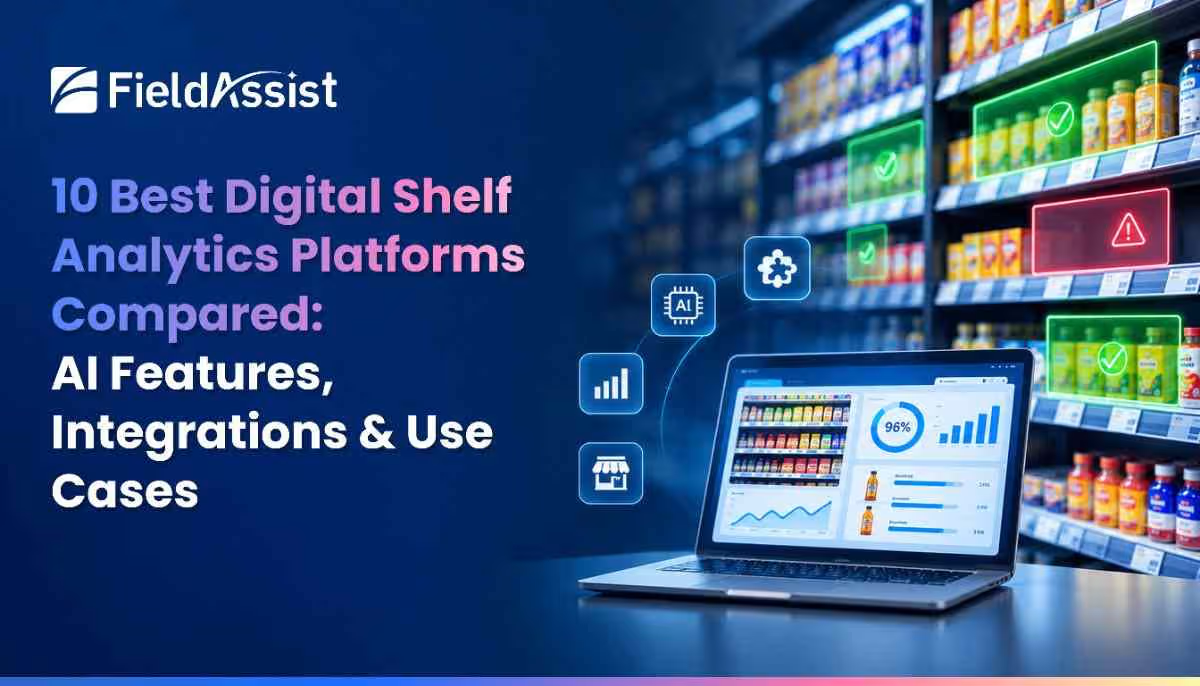
10 Best Digital Shelf Analytics Platforms Compared: AI Features, Integrations & Use Cases
A detailed comparison of 10 digital shelf analytics platforms by AI features, integrations, and use cases. Explore ecommerce shelf monitoring and FieldAssist’s AI-powered in-store shelf intelligence.

Have you ever wondered why brands with the most advanced data still lose at the shelf? It is because most brands do not have a planning problem, they have a follow-through problem.
Today, AI can flag an out-of-stock, weak product placement, visibility drop, pricing mismatch, or negative review in minutes. That sounds incredible on paper. But let’s be honest: a dashboard that identifies a loss without helping the right team act is not intelligence. It is just a well-formatted delay. The truly great digital shelf analytics platforms don't just show you the problem; they combine reliable data, AI-driven diagnosis, and connected workflows so your people can actually do something about it.
In this guide, we compare 10 digital shelf analytics platforms by their AI features, integrations, and use cases, while showing you exactly where FieldAssist IRIS adds real value on physical shelves a related, yet distinct, part of shelf execution.
What Is Digital Shelf Analytics?
Digital shelf analytics is the process of collecting and analyzing how products appear and perform across online retailers, marketplaces, and ecommerce product pages. It helps brands understand whether shoppers can find a product, whether the product information is accurate, whether it is in stock, how it is priced, and how it compares with competing products.
Common digital shelf analytics metrics include:
- Product availability and out-of-stock rate across online retailers.
- Search rank, share of search, and product discoverability.
- Product detail page content quality, imagery, titles, descriptions, and attribute completeness.
- Price and promotion compliance, assortment, and buy-box status where applicable.
- Ratings, reviews, sentiment, and competitor positioning.
A critical distinction: digital shelf analytics typically measures online retail environments. FieldAssist IRIS uses AI computer vision to analyze physical shelf images captured in stores. These use cases overlap around availability, visibility, and competitor presence, but their data sources and workflows are different. IRIS is best understood as an adjacent in-store shelf intelligence solution, not a direct replacement for software that crawls ecommerce product pages.
Which AI Features Matter Most in Digital Shelf Analytics Platforms?
AI is changing digital shelf analytics from periodic reporting into faster diagnosis and prioritization. The useful question is not whether a vendor claims to use AI. It is which decision the model improves, what data supports that decision, and whether a team can act on the result.
AI features vary by vendor, product tier, retailer coverage, and market. Treat a feature as available only when it is documented for the product and package being evaluated. For example, some vendors focus on online listing intelligence, while FieldAssist IRIS focuses on computer-vision-led physical shelf execution.
10 Best Digital Shelf Analytics Platforms Compared: Quick Comparison
The platforms below serve overlapping but not identical needs. FieldAssist is included for brands that need AI-powered physical shelf intelligence connected to retail execution. The other platforms primarily focus on online retail and ecommerce performance.
The 10 Digital Shelf Analytics Platforms, Reviewed
1. FieldAssist IRIS: Best Digital Shelf Analytics Platforms via In-Store Shelf Intelligence and Execution
Online visibility can create demand, but the sale can still be lost in a physical store if the product is missing, misplaced, poorly displayed, or excluded from the intended promotion. FieldAssist IRIS addresses that execution gap with AI image recognition and computer vision. It converts shelf photos into structured signals that teams can use to identify missing SKUs, shelf-position deviations, availability issues, and promotion gaps.
The distinction matters for FMCG and CPG brands with large general-trade networks. A traditional ecommerce digital shelf platform reads retailer product pages. IRIS reads physical shelves and connects the findings to in-store execution. In a broader shelf intelligence strategy, the two capabilities can complement one another: one helps brands understand online discoverability and availability, while the other helps them verify what shoppers actually encounter in stores.
FieldAssist reports outcomes including 25% better planogram compliance, 30% faster gap resolution, and 100% in-store execution visibility on its product page. These are vendor-published figures; confirm the measurement method, customer context, and period before using them as independently verified outcomes.
Five capabilities that differentiate FieldAssist IRIS
- AI shelf image recognition. Converts store images into SKU-level observations, including product presence, facings, misplaced items, and visible shelf gaps.
- Planogram and promotion compliance. Checks whether physical shelf arrangements and promotional displays match the brand’s defined execution requirements.
- Availability and share-of-shelf visibility. Helps teams identify out-of-stock signals, compare shelf presence, and review competitor visibility at store, SKU, category, and regional levels.
- Corrective-action workflows. Connects identified gaps to audit and task workflows so field teams can address the problem instead of leaving it in a report.
- Connected retail execution ecosystem. Can work alongside FieldAssist capabilities such as SFA and Perfect Store; the scope of integrations and replenishment workflows should be confirmed for the specific deployment.
Connect AI shelf analytics with field execution
CTA: See IRIS in Action
2. CommerceIQ
CommerceIQ focuses on digital shelf monitoring across retailers, linking availability, search rank, content compliance, and inventory signals with AI-led prioritization. It is relevant for brands seeking to move from issue detection toward coordinated commerce action.
3. Profitero+
Profitero+ combines digital shelf monitoring with sales and share insights across retailers and markets. Its offering covers content, pricing, availability, search, reviews, and integrations that help teams connect shelf performance to ecommerce outcomes.
4. NIQ Digital Shelf
NIQ Digital Shelf links online availability, product visibility, content quality, pricing, and search data with broader sales, shopper, and media insight. It suits brands seeking retailer-level analysis and evidence of commercial impact.
5. DataWeave
DataWeave combines digital shelf analytics with pricing intelligence, assortment analysis, and content optimization. Its AI-led product matching and marketplace metrics help brands compare availability, share of search, ratings, reviews, and competitor performance.
6. Intelligence Node
Intelligence Node applies AI, computer vision, natural language processing, and product matching to digital shelf monitoring. Its tools support price benchmarking, assortment comparison, content improvement, and large-scale retail catalog analysis across markets.
7. Salsify
Salsify connects product experience management with digital shelf reporting, helping brands review product-page content, spot outdated or overwritten information, and improve content performance. Its strongest fit is teams managing product content at scale.
8. Syndigo
Syndigo’s digital shelf analytics adds broader retailer coverage, frequent refreshes, pricing and availability monitoring, ratings and reviews, and product-content health. It is relevant for brands seeking shelf data alongside commerce content and retail analytics.
9. Stackline
Stackline Beacon monitors digital shelf performance across major ecommerce marketplaces, using AI to identify catalog and content issues. It can suit brands seeking a connection between shelf metrics, SEO, retail media, and broader commerce analytics.
10. 42Signals
42Signals tracks product availability, pricing, buy-box status, content, and competitor activity across ecommerce channels. Its digital shelf analytics is relevant for brands that need marketplace monitoring and alerts to respond to changes in product performance.
See why IRIS is the best choice for digital shelf monitoring > See Comparison
How Should Leaders Choose a Digital Shelf Analytics Platform?
Choose the platform based on the shelf problem you need to solve, not the length of its feature list. If the problem is online discoverability, retailer listings, prices, reviews, and digital availability, assess a dedicated digital shelf analytics platform. If the problem is physical shelf compliance, missing products, and execution follow-through, assess a computer-vision solution such as FieldAssist IRIS. If both matter, decide how the systems will share product, retailer, and performance data.
A practical rule: do not sign off on an AI demo alone. Test the platform against a representative set of your own SKUs, retailers, and exception cases. Measure data accuracy, useful alert rate, time to resolution, and the percentage of detected issues that reach closure.
Frequently Asked Questions About Digital Shelf Analytics
1. What is digital shelf analytics software?
Digital shelf analytics software monitors product visibility and performance across online retailers and marketplaces. It typically tracks availability, search rank, product-page content, pricing, assortment, ratings, reviews, and competitor activity.
2. Which metrics should a digital shelf analytics platform track?
Start with availability, share of search, search rank, content completeness, price and promotion compliance, ratings and review trends, and assortment. Add buy-box status or retailer-specific measures where relevant. Metricsshould map to a decision or accountable team.
3. How does AI improve digital shelf analytics?
AI can match products across retailer catalogs, identify anomalies, summarize review sentiment, recommend content changes, forecast risk, and prioritize alerts. More advanced workflows may automate approved actions. Buyers should test accuracy and actionability, not just the presence of AI labels.
4. What is the difference between digital shelf analytics and in-store shelf analytics?
Digital shelf analytics typically studies online product listings and ecommerce signals. In-store shelf analytics uses store images or other physical retail data to assess availability, facings, planogram compliance, and promotions. The two are complementary but not interchangeable.
5. How much does digital shelf analytics software cost?
Pricing depends on SKU count, retailer and country coverage, refresh frequency, modules, integrations, and services. Many enterprise platforms use quote-based pricing. Ask for a total-cost view that includes onboarding, data access, integration, support, and expansion.
FieldAssist IRIS: Strategic Capabilities for In-Store Shelf Intelligence
For brands whose shelf problem exists inside stores, FieldAssist IRIS is most valuable when image recognition becomes part of a repeatable execution process. The following table describes its role and the business decision each capability supports. Exact integrations and workflow behaviour depend on deployment configuration.
Bottom line
Digital shelf analytics helps brands understand what shoppers see and can buy online. FieldAssist IRIS helps brands understand what shoppers encounter on physical shelves and how store teams execute against the plan. For consumer brands operating across both environments, the strategic opportunity is to connect these signals without confusing the two categories.