Top 7 Benefits of Digital Transformation in Retail
Top 7 benefits of digital transformation in retail, from improved operational efficiency and inventory management to smarter decisions and better retail execution.

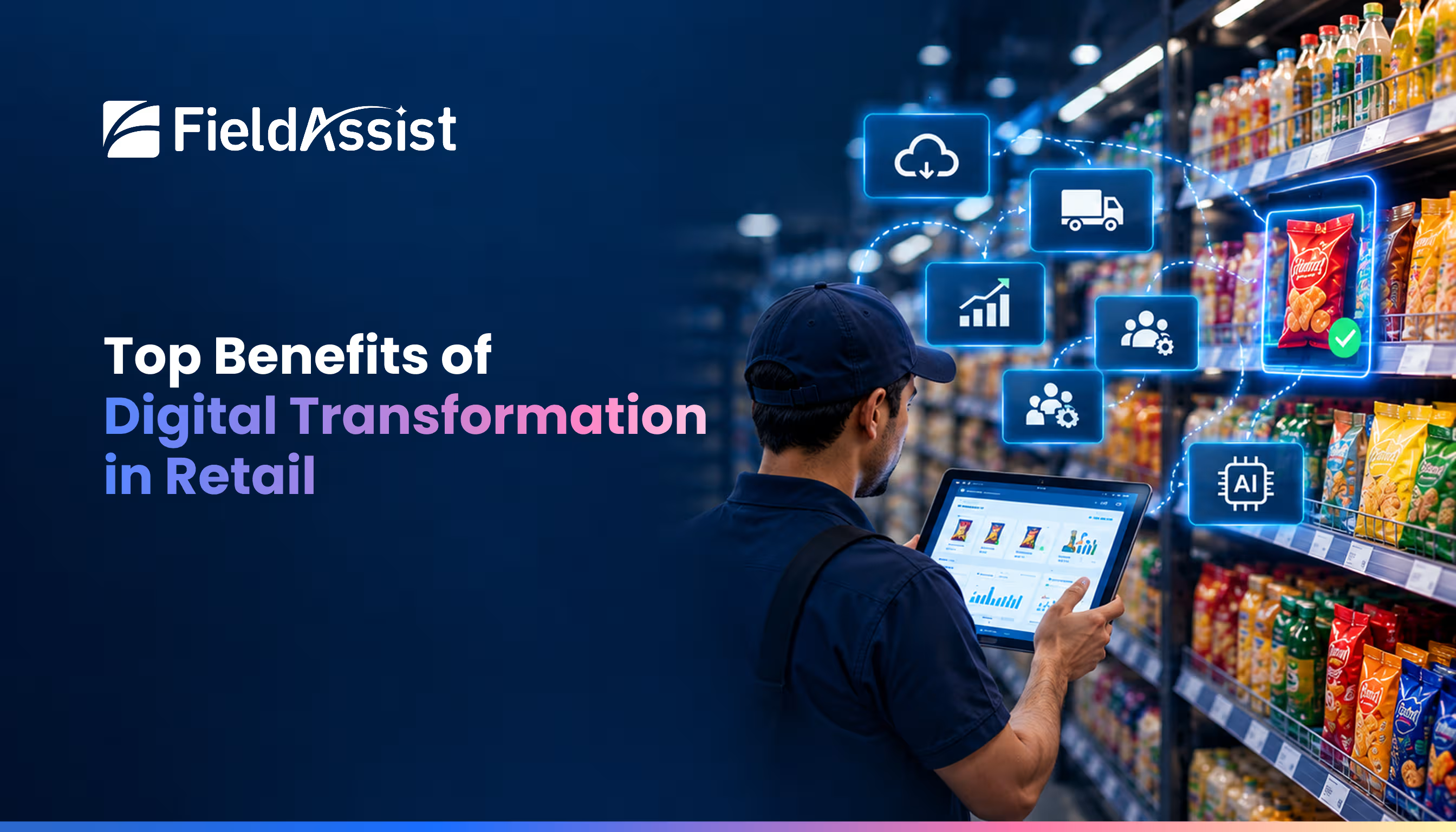
Every CPG leader knows the gap. The strategy is signed off in the boardroom, but it quietly breaks down at the shelf, in the van, or on the distributor’s ledger. That is the last mile execution gap, and it is where retail digital transformation either pays off or stalls.
What is Digital Transformation?
Digital transformation is the shift from paper, spreadsheets, and disconnected tools to connected systems that capture, move, and act on data in real time. It is not a software purchase. It is a change in how a business plans, sells, serves, and learns.
In a retail setting, that means retiring the handwritten order book, the WhatsApp photo audit and the month-end Excel reconciliation. In their place come mobile sales apps, distributor management systems, image recognition, geospatial analytics and AI that flags what to do next. For CPG and FMCG brands, which sell through thousands of outlets they do not own, the change has to reach the outlet itself. A head office dashboard means little if the shelf data feeding it is three weeks old.
Real transformation has three layers. First, capture: every visit, order and audit is recorded digitally at the point of action. Second, connect: field, distributor and retailer data flow into one system instead of five. Third, act: managers and reps get clear recommendations, not just reports. Skip any layer and the program stalls at pilot stage.
Why is Digital Transformation Important in Retail?
Retail margins are thin, and the cost of getting execution wrong is measurable. IHL Group’s 2026 Inventory Distortion Study puts the global cost of out-of-stocks and overstocks at $1.7 trillion a year, or 6.2% of global retail sales. That is money lost to empty shelves, bloated stockrooms, and planning errors that better data could have caught.
Three pressures make the case hard to ignore:
- Fragmented channels. General trade, modern trade, e-commerce and quick commerce each expect different service levels from the same brand.
- Volatile demand. Tariffs, promotions, and shifting consumer budgets punish forecasts built on last quarter’s sales.
- Field-team capacity. Reps cover more outlets in the same hours, and manual reporting eats into selling time.
Retail digital transformation answers these pressures by replacing guesswork with live data. The brands that treat it as an operating discipline rather than an IT project are the ones closing the distance between plan and shelf. The shift matters even more in markets where general trade dominates, because millions of small outlets still run on verbal orders and paper registers, and every handoff is a place where information gets lost.
Top 7 Benefits of Digital Transformation in Retail
The benefits of digital transformation in retail show up on the P&L, in the field, and on the shelf. Here are the seven that matter most.
1. Improves Operational Efficiency and Productivity
Manual processes are a quiet tax on every field operation. Reps lose hours to order entry, route planning, expense claims, and reporting, and supervisors lose more chasing those reports. Digitizing these workflows through mobile apps and automated approvals hands that time back to selling.
The gain compounds at scale. When beat plans, attendance, order capture, and claim settlement run on one platform, managers stop reconciling and start coaching. Area managers can see who is behind on calls before the month ends, not after it. McKinsey estimates that generative AI could add $400 billion to $660 billion a year across retail and consumer packaged goods, through productivity gains of 1.2 to 2 percent of annual revenues.
2. Enhances Customer Experience and Engagement
In CPG, the customer is both the shopper and the retailer. Shoppers want the product on the shelf at the right price. Retailers want fast order fulfillment, accurate schemes, and a rep who knows their store. Digital tools serve both.
Retailer ordering apps let outlet owners place orders and track deliveries without waiting for a visit. Digital scheme communication prevents the “I was told something different” dispute at settlement. A rep who opens the app to see purchase history, open claims, and recommended SKUs walks in with a conversation worth having, not a generic pitch. Personalization is no longer reserved for e-commerce; recommending the right products to the right outlet works just as well in general trade.
3. Enables Data-Driven Decision-Making
Most CPG organizations have plenty of data and very little they can act on by Thursday. Sales sit in the DMS, audits in photo folders, promotions in spreadsheets, and territory plans in someone’s head. Digital transformation pulls these into a single view, with one definition of an active outlet, a productive call, and a compliant shelf.
With unified data, leaders can answer practical questions fast. Which outlets are slipping? Which distributors are overstocked on slow movers? Which beats should be merged? AI then goes a step further by recommending actions rather than only reporting numbers. Gartner predicts that 70% of large organizations will adopt AI-based forecasting to predict future demand by 2030, a clear sign of where planning is headed.
4. Improves Inventory Management and Product Availability
An empty shelf is a lost sale that never appears on a report. The cause is usually mundane: a late order, a missed replenishment, a distributor with no visibility into outlet-level demand.
Digital inventory tools track stock at distributor and outlet level, flag low-stock SKUs before they run out, and suggest order quantities based on actual sell-through. McKinsey’s research on AI in supply chains indicates that AI-driven forecasting can reduce forecasting errors by 20 to 50 percent and cut lost sales from product unavailability by up to 65 percent. For a CPG brand, that means fewer stockouts on hero SKUs and less working capital trapped in dead stock. It also helps distributors, who stop carrying safety stock out of fear and start ordering to real demand.
5. Increases Sales and Revenue Growth
Revenue growth comes from small, repeatable wins across thousands of outlets: wider coverage, more lines per call, stronger scheme compliance, and fewer lost orders. Suggested orders and product recommendations lift basket size. Geo-tagged outlet data and white space analysis show where unserved demand sits, so teams expand into the right micromarkets rather than the loudest ones.
Faster claim and scheme settlement helps too. A retailer who is paid on time is a retailer who keeps stocking your range.
6. Strengthens Supply Chain and Distribution Management
For CPG brands, visibility usually stops at the distributor. A distributor management system extends it, putting primary and secondary sales, claims, inventory, and fill rates in one place. Brands can see which distributors deliver on time, which sit on aging stock, and which routes are underserved.
The technology will only deepen. Gartner forecasts that supply chain management software with agentic AI will grow from under $2 billion in 2025 to $53 billion in spend by 2030. For retail and CPG leaders, the signal is plain: distribution decisions are moving from monthly reviews to continuous, AI-assisted planning. Brands that digitize the distributor layer now will be ready for it.
7. Improves Retail Execution and Market Visibility
Retail execution is where strategy meets the shelf. Planogram compliance, share of shelf, promotion adherence, and pricing all depend on what happens inside the outlet, and manual audits capture only a sample, after the fact. Image recognition changes that. A rep photographs the shelf, and AI reads facings, out-of-stocks, and competitor presence in seconds, giving managers outlet-level evidence instead of self-reported scores.
Market visibility extends beyond the store. Geospatial data shows outlet density, coverage gaps, and potential by micromarket, so planning rests on what the market actually looks like rather than what the territory map assumes. For a brand launching a new SKU or entering a new city, that clarity is the difference between a targeted rollout and an expensive guess.
How FieldAssist Supports Digital Transformation in Retail?
FieldAssist was built for the last mile, the stretch between a brand’s plan and the retail outlet where most execution gaps open up. Our platform connects field sales, distributors, and retail data so CPG teams work from the same facts, which makes digital transformation in retail practical rather than theoretical. Whether the starting point is a field sales team still on paper or a mature setup that lacks shelf-level insight, the platform is designed to be adopted in stages.
- Automating Field Sales and Retail Execution
FieldAssist’s Sales Force Automation software handles beat planning, order capture, attendance, scheme communication, and claims in a single mobile workflow, so reps spend less time on admin and more time in outlets. Image recognition (IRIS) and Perfect Store scoring turn every visit into structured shelf data, so execution is measured the same way in every territory.
- Improving Sales and Distribution Visibility
The FieldAssist Distributor Management System gives brands live visibility into primary and secondary sales, distributor inventory, and claims. Micromarket adds location intelligence, mapping outlet coverage and white space so territory and route decisions reflect real market potential. Instead of waiting for month-end reports, sales heads see where volume is leaking while there is still time to fix it.
- Enabling AI-Powered Insights and Smarter Decisions
FieldAssist’s AI layer, including the Pulse AI Co-Pilot, turns this data into recommended actions: which outlets to prioritize, which products to push, and where an execution gap is opening. The aim is not another dashboard. It is a clear next step for the rep, the area manager and the sales head, delivered where they already work. Explore the full platform at fieldassist.com.
Closing Thoughts
The case for retail digital transformation is no longer theoretical. The seven advantages above, from leaner field operations to sharper shelf visibility, trace back to one idea: close the distance between what head office plans and what the outlet receives. Digital transformation in retail rewards brands that begin with a specific execution problem, prove value in a few territories, and scale from there.
The brands pulling ahead are the ones that see the last mile as clearly as they see the boardroom. If you are ready to close that gap, the FieldAssist team can show you how.
Frequently Asked Questions (FAQs)
1. What are the key benefits of digital transformation in retail?
The main gains are higher field productivity, better customer engagement, data-led decisions, improved stock availability, revenue growth, stronger distributor management, and clearer retail execution. Together they shrink the gap between the plan and in-store reality, and they give leadership a faster, more reliable read on the market.
2. What technologies are used in retail digital transformation?
Common technologies include sales force automation apps, distributor management systems, image recognition, geospatial analytics, AI-powered forecasting and recommendation engines, and integration platforms that connect them to ERP and POS data.
3. How does digital transformation improve retail operations?
It automates manual work such as order entry, claims, and reporting, standardizes how outlets are visited and audited, and gives managers live data. Teams spend less time reconciling and more time acting. Supervisors can also spot problems such as missed visits, low order values, or stock gaps the same day, not at month-end.
4. What are the challenges of digital transformation in retail?
Typical hurdles include poor data quality, legacy systems that do not integrate, low field adoption, and unclear ownership. In emerging markets, patchy connectivity and fragmented general trade add complexity. Offline-capable apps, simple workflows, and a phased rollout help. Strong training and visible leadership support matter as much as the software itself.
5. How can retailers get started with digital transformation?
Start with one measurable execution problem, such as out-of-stocks or order capture, and choose a platform that fits how your field teams actually work. Pilot in a few territories, track a small set of KPIs, fix adoption issues, then scale. Choose a partner with proven experience in your market and channel mix, because field realities vary widely between regions.