A Complete Guide to Beat Planning in FMCG
A practical guide to beat planning in FMCG, covering outlet segmentation, visit frequency, route optimization, automation, and sales rep productivity.

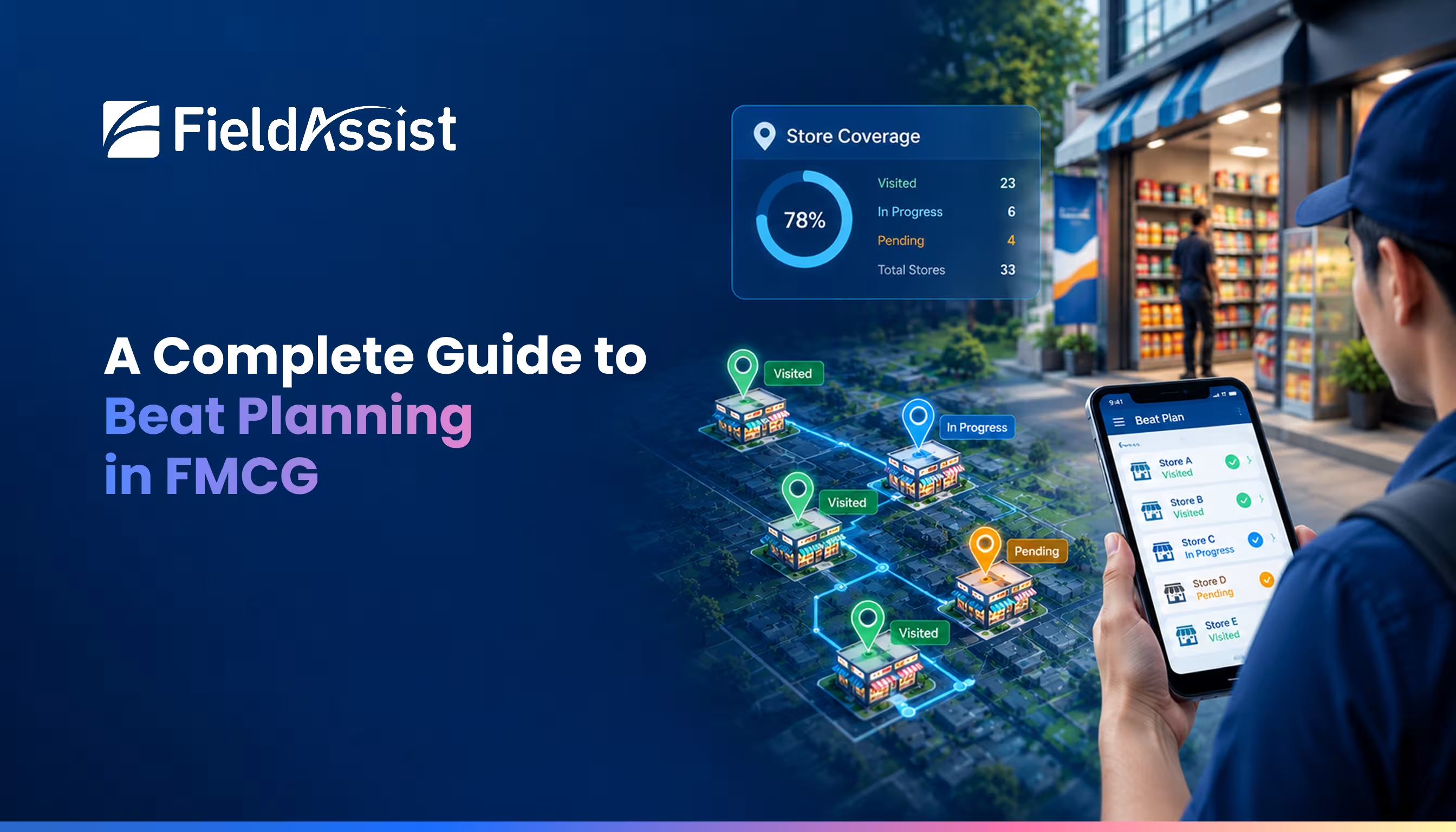
Every FMCG sales leader has seen it: the distributor is stocked, the scheme is live, the brand is funded, and the outlet still has an empty shelf. The gap sits in the last mile, between the plan on paper and what a sales rep actually does at the counter. A disciplined beat plan in sales is the mechanism that closes it. This guide covers what a beat plan is, why it matters, where it breaks, and how to build one that holds up in general trade.
What is a beat plan in FMCG sales?
A beat plan is a structured schedule that tells a field sales representative which outlets to visit, on which day, in what sequence and how often. A “beat” is the fixed set of retail outlets, usually in one geographic cluster, assigned to a rep and covered on a recurring cycle, typically weekly or fortnightly.
In markets where general trade and neighbourhood stores still carry most of the volume, a beat plan in sales is the backbone of secondary sales. It decides coverage (which outlets get seen), frequency (how often) and sequence (in what order). It also carries the rest of the route-to-market engine, because order capture, scheme communication, merchandising, collections and distributor billing all ride on the visit.
A good plan is not a list of outlets. It is a set of decisions about where a rep’s limited hours earn the highest return.
Why Is Beat Planning Important for FMCG Businesses?
FMCG is won or lost at the shelf, and the shelf is serviced by people on routes. Three reasons beat planning deserves attention at the leadership table.
Availability. Empty shelves are the costliest symptom of weak coverage. IHL Group’s 2026 Inventory Distortion Study puts global inventory distortion, the combined cost of out-of-stocks and overstocks, at $1.7 trillion a year, equal to 6.2% of global retail sales. NielsenIQ earlier found that 7.4% of U.S. CPG sales went unrealized in 2021 because items were out of stock or off the shelf, a $82 billion loss for retailers. Different markets, same lesson: a missed visit often becomes a missed sale.
Productivity. A rep’s day is a fixed asset. Every kilometre of backtracking, every duplicate call and every low-value outlet visited at the wrong frequency is selling time you cannot recover.
Predictability. When the beat plan in sales is stable, managers can forecast calls, measure strike rate and lines per call, compare reps fairly and spot slippage within days instead of at month-end.
What Are the Common Challenges in FMCG Beat Planning?
Most beat plans do not fail at design. They decay in the field. Six breakdowns recur.
Inaccurate or Outdated Outlet Data
Beats are built on an outlet master. If it lists closed shops, misses new ones, carries wrong GPS pins or tags a high-volume store as low potential, every downstream decision inherits the error. Fragmented trade makes this harder: McKinsey’s work on emerging markets notes that small independent retailers rarely have modern POS systems, so companies must build their own information sources or risk missing growth opportunities.
Overlapping Territories and Missed Outlets
When territories are drawn by distributor boundary or rep memory, two reps end up serving the same lane while a lane two streets away goes unvisited. Overlaps waste calls. Gaps hand share to the competitor whose rep does show up. Neither is visible in a spreadsheet, but both show up in numeric distribution.
Inefficient Routes and Excessive Travel Time
Routes built by habit rather than geography zigzag. Reps cross the same market twice, lose hours in traffic and reach their last outlets after shutters are down. In dense cities and in regions with poor roads, travel can consume more of the day than the calls themselves, and the cost is not just fuel. It is fewer productive calls.
Uneven Workloads Across Sales Representatives
Picture one rep carrying 55 outlets and another carrying 28. The first rushes and skips merchandising. The second has idle hours that nobody notices. Overload hurts execution quality: Gartner’s survey of 1,026 B2B sellers found that overwhelmed sellers are 45% less likely to attain quota. That research covers B2B selling broadly rather than FMCG field teams specifically, but any area sales manager will recognize the pattern.
Changing Retailer Demand and Market Conditions
Outlets change faster than beat plans. A school reopens, a weekly market moves its day, a wholesaler opens nearby, a festive season or Ramadan shifts buying, a retailer moves from fortnightly to weekly ordering. A static plan treats peak week like a slow Tuesday.
Limited Visibility into Field Execution
Many organizations still know what a rep planned, not what the rep did. Without GPS-stamped check-ins, visit duration and order data, adherence is self-reported. Managers learn about skipped outlets when the retailer calls the distributor. Planning cannot improve on execution data that never reaches it.
Key Benefits of Beat Planning Automation
Spreadsheet planning of a beat plan in sales can work for 20 reps. It stops working at 200. Automation brings outlet data, geography and business rules into one place.
Improved Retail Outlet Coverage
Using outlet coordinates and potential, automated planning assigns every active outlet to exactly one beat. That closes overlaps and exposes unserved pockets. Coverage becomes a number you can audit instead of an impression.
Optimized Routes and Reduced Travel Time
Routing logic sequences outlets by proximity and visit windows, so reps stop retracing roads. Less drive time means more of the day spent inside the outlet, where orders, displays and relationships are made.
Increased Sales Rep Productivity
When routes are tight and workloads balanced, productive calls per day rise without adding headcount. Reps spend less time deciding where to go next and more time on strike rate, lines per call and in-store execution.
Reduced Manual Errors and Scheduling Conflicts
Manual scheduling produces double-booked outlets, forgotten holidays and beats that clash with leave. System-driven scheduling applies the rules once, handles leave and holiday substitution, and removes the weekly planning exercise that eats a sales manager’s Sunday.
Real-Time Tracking and Data-Driven Optimization
GPS-verified check-ins, visit duration and order capture feed dashboards as the day unfolds, so managers see beat adherence live and correct mid-week. Over time the data shows which outlets deserve more visits and which beats are over-served, so the plan improves on evidence rather than opinion.
How to Create an Effective Beat Plan in FMCG
Build in this order. Skipping ahead to routes before the outlet data is clean is the most common reason plans fail.
Step 1: Map and Audit Retail Outlets
Start with the universe, not the plan. Geo-tag every outlet, confirm it is active and capture channel, size, category presence and ownership. A field census with rep and merchandiser input beats a distributor list. In a McKinsey case study, a consumer-goods company in Latin America used geospatial analytics and prioritization mapping to understand potential store by store, and boosted sales in its pilot outlets by 40 percent. That is one company’s pilot, not a benchmark, but it shows what outlet-level clarity can unlock.
Step 2: Segment Outlets Based on Sales Potential
Not every outlet deserves the same attention. Classify outlets by current sales, growth potential, category depth, location and strategic importance, then tier them, for example Platinum, Gold, Silver and Bronze. Use potential, not just past sales, because a store buying little today may be under-served rather than unimportant. Keep the logic simple enough that a rep can explain why an outlet sits in its tier.
Step 3: Define Outlet Visit Frequency
Frequency follows tier. High-potential outlets might be visited weekly, mid-tier outlets fortnightly, and the long tail monthly or through telesales, distributor salesmen or an eB2B ordering channel. Factor in replenishment cycles, shelf space and whether the outlet needs merchandising support. Frequency is where segmentation turns into workload, so set it before you cut territories.
Step 4: Divide Territories and Assign Beats
Cluster outlets into compact, contiguous beats using geography, natural boundaries, distributor reach and travel time rather than administrative lines. Each beat maps to one rep and one day of the cycle. Check that every active outlet sits in exactly one beat and that distributor and rep boundaries do not collide.
Step 5: Plan Daily Routes and Visit Sequences
Within each beat-day, sequence outlets to minimize backtracking while respecting opening hours, distributor delivery windows and priority calls. Put high-value outlets early, when stock, energy and open shutters are all in your favour. Leave a buffer for traffic and one or two ad-hoc calls. As an illustration only, 420 minutes of field time with 8 minutes per outlet and 5 minutes of travel between calls supports about 32 calls. Replace those placeholders with your own time-and-motion data.
Step 6: Allocate Workloads to Sales Representatives
Balance by total effort, not outlet count. Weigh visit frequency, time per outlet, travel, order complexity and merchandising tasks. Compare reps on planned hours and expected productive calls, then rebalance beats that run hot or cold. Pilot in one or two territories, track adherence and strike rate for a full cycle, then scale. This is where a beat plan in sales stops being a drawing and becomes an operating rhythm.
How FieldAssist Helps FMCG Businesses Optimize Beat Planning
We don’t just sell software. We solve the last-mile execution gap between a brand’s route-to-market strategy and what happens at the outlet. For beat planning, that means connecting the pieces most teams run in separate tools:
- Outlet universe and white space: Micromarket, FieldAssist’s location intelligence product, shows where outlets and untapped potential sit, so beats are built from a map rather than a legacy list.
- Beat planning and route optimization: FieldAssist’s Sales Force Automation (SFA) app lets teams define beats, frequencies and sequences centrally and run them on reps’ phones, with geo-tagging and attendance data that show adherence as it happens.
- Distributor alignment: the Distributor Management System (DMS) keeps coverage, secondary orders and distributor stock in step with the plan.
- Execution proof: IRIS image recognition and Perfect Store show not only that the visit happened, but what the shelf looked like when the rep left.
- Continuous improvement: real-time analytics highlight over-served beats, skipped outlets and idle capacity, so planning cycles run on evidence.
The result is a beat plan in sales that reps can follow, managers can verify and leadership can trust. To see how this works for your territories, visit FieldAssist.
Frequently Asked Questions About Beat Planning in FMCG
1. What is the difference between a beat plan and a route plan?
A beat plan defines which outlets belong to a rep’s beat, which day each is covered and how often. A route plan is the path and visit sequence for a given day within that beat. The beat plan answers “who, where and how often”; the route plan answers “in what order and by which road.”
2. What is the difference between a beat plan and a Permanent Journey Plan (PJP)?
The two terms overlap, and usage varies by company. In most FMCG organizations a PJP is the approved, recurring visit calendar that comes out of the beat plan, locked in the system so adherence can be measured against it. Think of the beat plan as the design logic and the PJP as the schedule reps are held to.
3. How many outlets should a sales representative visit in a day?
There is no universal number. It depends on outlet density, average time per visit, travel time, order complexity and merchandising scope. Dense urban beats support more calls than semi-urban or rural ones. Use the formula in Step 5: available field minutes divided by average visit time plus average travel time, then validate through a pilot.
4. How often should an FMCG beat plan be updated?
Review adherence and productivity monthly, and run a formal re-plan at least quarterly. Update sooner when triggers appear: new or closed outlets, distributor changes, rep attrition, major scheme launches or seasonal demand shifts. Outlet data should be refreshed continuously through field updates.