FieldAssist FAi Suite: 9 AI Tools Powering Modern Route-to-Market Execution
Learn how FieldAssist’s FAi Suite uses 9 AI tools for route optimization, smarter SKU recommendations, inventory planning, and better FMCG route to market execution.

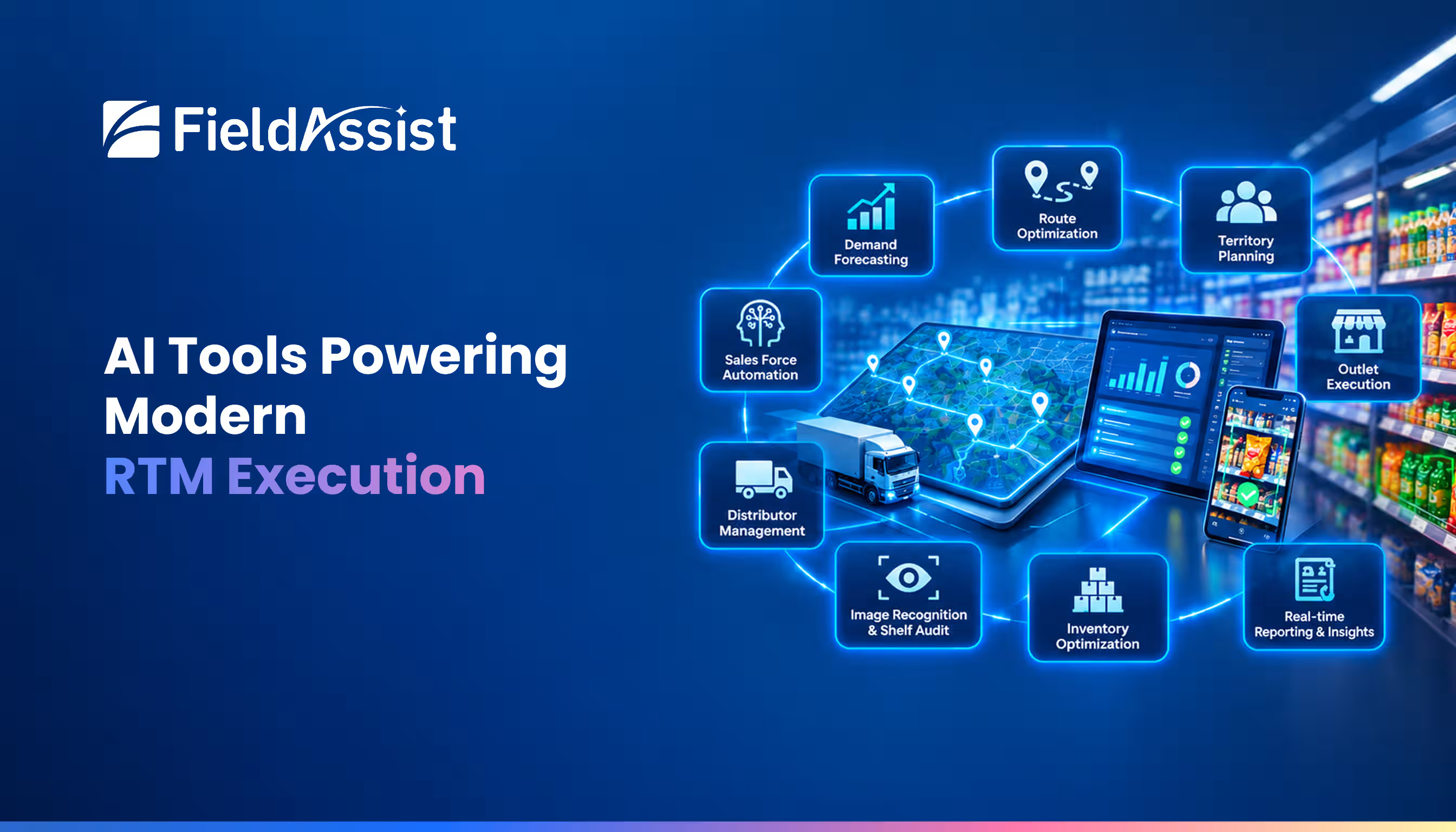
Every FMCG brand has a plan on paper. The gap opens in the last mile: a rep skips a beat, a shelf goes empty, a distributor sits on stale stock, and the plan never reaches the outlet. That gap, not the strategy deck, decides who wins the street. FieldAssist’s FAi Suite is built to close it. This guide covers what RTM really involves, where traditional models break, and how nine AI tools turn visibility into execution.
What Is Route to Market (RTM) in FMCG?
RTM is the network of channels, distributors, field teams and retailers that carries a product from the factory to the shopper. In FMCG, that means primary and secondary sales, distributor stock, beat coverage, scheme delivery and, finally, the shelf. Each hand-off is a place where intent gets lost.
A sound RTM strategy decides which outlets to serve, through which channel, at what frequency and with which assortment. Execution decides whether any of that happens on a Tuesday morning in a kirana in Lucknow or a duka in Nairobi.
In emerging markets the picture is more fragmented. Millions of small outlets are served through distributors, wholesalers and van sales, and visibility drops with every tier. That is why RTM in FMCG is an execution discipline as much as a distribution one.
Why Traditional FMCG Route to Market Strategies Need AI?
Spreadsheets, monthly reviews and static beat plans were built for a slower market. Bain & Company found that insurgent brands captured about 36% of US FMCG growth in tracked channels in 2025 while holding less than 2% of market share. Challengers win on velocity and local agility. Incumbents with national distribution cannot afford to execute slower. Five breakpoints show up again and again.
- Limited Visibility into Retail Execution
Most brands see secondary sales after the fact. What they cannot see is why: whether the planogram was followed, whether a competitor display is crowding out facings, whether the promotion was ever set up. Manual audits cover a sliver of outlets, on a lag, on a rep’s own judgment. Leadership ends up steering by invoices while the shelf tells a different story.
- Inefficient Sales Routes and Beat Planning
Beats are often set once a year and rarely revisited. High-potential outlets get the same visit frequency as low-value ones, reps double back across territory, and new outlets wait months to enter a route. Travel time quietly eats selling time, and coverage gaps hide inside the average.
- Missed Sales Opportunities at the Outlet Level
A rep with a standard pitch and no outlet history repeats last month’s order. Cross-sell and scheme opportunities go unspotted. Availability is the clearest example: NielsenIQ notes that out-of-shelf situations cost the US retail industry $69 billion in 2023. Behind every unit of that figure is a sale some brand’s field team could have protected.
- Inventory Gaps and Unpredictable Demand
Distributor stock is usually planned on historical averages, so fast movers run dry while slow movers age. IHL Group sizes global inventory distortion, the combined cost of out-of-stocks and overstocks, at $1.7 trillion, or 6.2% of retail sales, in 2026. The share is shrinking, but it still shows what guesswork costs.
- Disconnected Sales and Distribution Operations
When SFA, DMS, scheme claims and shelf audits sit in separate tools, insight arrives too late to act on. Claims are reconciled weeks later, and the rep never learns that the distributor was out of stock before the visit. An FMCG Route to Market model that cannot share data between brand, distributor and field runs on three versions of the truth.
What Is FieldAssist’s FAi Suite?
FAi is FieldAssist’s AI layer for the frontline, built on three pillars: Information, Insight and Impact. It aggregates execution data across sales, distribution and retail, applies predictive analytics to surface priorities, and pushes actionable nudges to reps, managers and distributors. The platform runs across 32+ countries, with 8.9 million outlets, 190K users and 75K distributors on the network.
FieldAssist reports these outcomes from the suite: a 25% improvement in planogram compliance, a 13% increase in outlet coverage, 18% better beat-level targeting precision, 21% more productive outlet calls with real-time nudges, and 90% order accuracy through intelligent SKU mapping. The aim is a closed loop from insight to action inside the outlet, not another dashboard.
9 AI Tools in FieldAssist’s FAi Suite Powering Modern RTM Execution
1. Route Optimization: Build Smarter Sales Routes and Improve Outlet Coverage
FieldAssist Route Optimization software uses AI to plan smarter routes, reducing travel time, cost and delivery uncertainty. It replaces annual, static beats with plans built around where sales actually are, so reps spend more of the day in outlets and less on the road. It is the first lever in any RTM strategy, because every other tool assumes the rep is in the right outlet. Consistent coverage of high-value outlets compounds over a quarter, and sales heads get a route plan they can actually defend.
2. IRIS (Image Recognition): Automate Retail Shelf Audits and Improve Visibility
IRIS applies image recognition software to detect availability, share of shelf, pricing and visual merchandising accuracy. It swaps subjective manual audits for consistent, outlet-by-outlet evidence, and turns Perfect Store insights into personalised recommendations for reps and managers. Because every shelf is read the same way, a regional manager and a head-office team work from the same facts. That consistency is what makes audit data usable for decisions, not just for reporting.
3. Perfect Store: Improve In-Store Execution and Planogram Compliance
Perfect Store audits shelf execution in real time against planogram and display KPIs. Gaps can be corrected during the visit instead of being discovered in next month’s review. For brand teams, it turns “we think the display is up” into a scored, comparable view across outlets. IRIS then converts those Perfect Store insights into personalised recommendations, so audit data produces a to-do list rather than a report.
4. Product Recommendations: Enable Smarter SKU and Order Suggestions
This AI product recommendation engine suggests SKUs, combos, schemes and quantities for each outlet. Gartner found that sales organizations giving sellers AI-enabled next best actions are 2.6x more likely to achieve commercial growth. In the field, that means a rep walking in with the right order for this outlet, not a copy of last month’s. Because recommendations cover combos, schemes and quantities, they also help reps position promotions that an outlet would otherwise never hear about.
5. ARS (Auto Replenishment System): Predict Demand and Prevent Stockouts
ARS predicts demand and replenishes inventory automatically, so stockouts are prevented rather than chased. It targets the distributor-level gap described earlier: stock decisions driven by predicted demand instead of historical averages, which protects both availability and working capital. The practical test is simple: fewer retailers asking where the stock is, and fewer distributors carrying slow-moving inventory they never planned to hold.
6. Micromarket: Identify Local Growth Opportunities and Untapped Retail Markets
Micromarket, FieldAssist’s location intelligence software combines local market intelligence with white space analysis to show where demand is unserved or under-served. Rather than expanding on national averages, teams can plan coverage micro-market by micro-market and put distributor and rep capacity where the opportunity is. For leadership, it answers the question every expansion plan stalls on: which markets to enter first, and what capacity they will need.
7. FAi DMS Agent: Streamline Distributor Operations and Trade Promotion Management
The FAi DMS Agent manages trade promotions, schemes and claims directly from the distributor’s system to reduce leakages. Distributor operations are where money and trust leak: late claim reconciliation, inconsistent scheme application. An agent working inside the DMS tightens that loop. Cleaner claims also mean fewer disputes with distributors, which protects the relationship the whole network depends on.
8. FA One L&D: Improve Sales Rep Productivity Through AI-Powered Learning
FA One Learning & Development software delivers in-workflow microlearning and skill coaching to upskill reps and shorten onboarding time. Training sits inside the tool reps use every day, not in a classroom they attend once a quarter, which matters in high-attrition field teams. New reps reach productive calls sooner when guidance appears at the moment of the visit.
9. NOVA: Enable AI-Powered Retailer Engagement and Conversational Selling
NOVA is a conversational AI agent for retailers. It suggests reorders, SKUs and schemes, sustaining sales even when the rep is absent. The days between visits are a blind spot in most RTM models, and NOVA keeps the retailer conversation, and the order flow, going. For retailers, that is an easier way to reorder. For the brand, it means fewer lapsed outlets and less dependence on visit frequency alone.
The Future of Route to Market: From Visibility to Intelligent Execution
The first wave of RTM digitisation gave brands visibility: where reps went and what was sold. The next wave closes the loop between seeing and doing. McKinsey estimates that generative AI could add $400 billion to $660 billion a year in retail and consumer packaged goods, and much of that value will be captured in execution, not reporting.
Agentic tools such as the FAi DMS Agent and NOVA point the way: software that acts on distributor claims and retailer reorders, not just flags them. The RTM strategy of the next few years will not be reviewed quarterly. It will adjust daily, outlet by outlet, and brands that treat FMCG Route to Market as a learning system will pull ahead. Intelligence also has to travel with the rep. FAi’s premise is that insight should arrive inside the workflow, as a nudge at the right outlet, rather than in a report read days later.
How to Implement AI in Your FMCG Route to Market Strategy?
1. Identify Gaps in Your Existing RTM Model
Start with a diagnostic, not a vendor demo. Map where intent breaks down: coverage, shelf compliance, distributor stock, claim turnaround, rep ramp-up. Rank the gaps by revenue at stake. Involve sales, distribution and trade marketing together; each sees a different part of the leak.
2. Integrate Sales, Distribution, and Retail Data
AI is only as good as the data it sees. Connect SFA, DMS and retail audit data so one outlet has one record across brand, distributor and field. Clean outlet master data is the unglamorous step that decides whether recommendations are trusted.
3. Prioritize AI Tools Based on Business Objectives
Do not switch on nine tools at once. If availability is the pain, begin with IRIS, Perfect Store and ARS. If coverage is the pain, begin with Route Optimization and Micromarket. Pilot in one region, prove the KPI movement, then sequence the rest as the first wins land.
4. Track Performance Through Relevant RTM KPIs
Track numeric distribution, strike rate, lines per call, on-shelf availability, planogram compliance, fill rate, scheme claim turnaround and cost to serve. Review them weekly, by territory, so corrections happen in days. Set a baseline before go-live so improvement is measurable, not anecdotal.
Frequently Asked Questions About AI-Powered Route to Market
What is a Route to Market strategy in FMCG?
It is the plan for how a brand reaches shoppers: which channels, distributors and outlets to serve, how often, with what assortment and schemes, and how performance is measured at the shelf. In FMCG, it must also account for fragmented outlet universes and multi-tier distribution.
How does AI improve FMCG Route to Market execution?
AI turns scattered field, distributor and retail data into outlet-level actions: better routes, recommended orders, shelf audits from photos, predicted stock needs. Decisions move from monthly reviews to the point of sale, and reps get recommendations inside their workflow instead of in a report.
What are the benefits of AI-powered RTM tools?
Better coverage, stronger planogram compliance, fewer stockouts, more accurate orders, tighter scheme control and faster rep ramp-up, all driven by data the field already generates. Over time, that compounds into stronger outlet-level growth.
How does FieldAssist FAi Suite support Route to Market optimization?
FAi brings nine AI tools, from Route Optimization and IRIS to NOVA, onto one platform connected with FieldAssist’s SFA and DMS, so insight, recommendation and action stay linked. That continuity is what separates a suite from a set of disconnected point tools.
How can FMCG companies measure the success of an AI-powered RTM strategy?
Compare before and after on outlet-level KPIs: coverage, strike rate, on-shelf availability, planogram compliance, order accuracy and cost to serve. Tie each tool to the one KPI it is meant to move, and review monthly so gains can be attributed tool by tool.