African RTM Without AI Is Yesterday’s Strategy
Stop relying on outdated RTM playbooks in Africa. Discover why AI, predictive analytics, and agentic automation are the only way to win in African FMCG in 2027 and beyond.

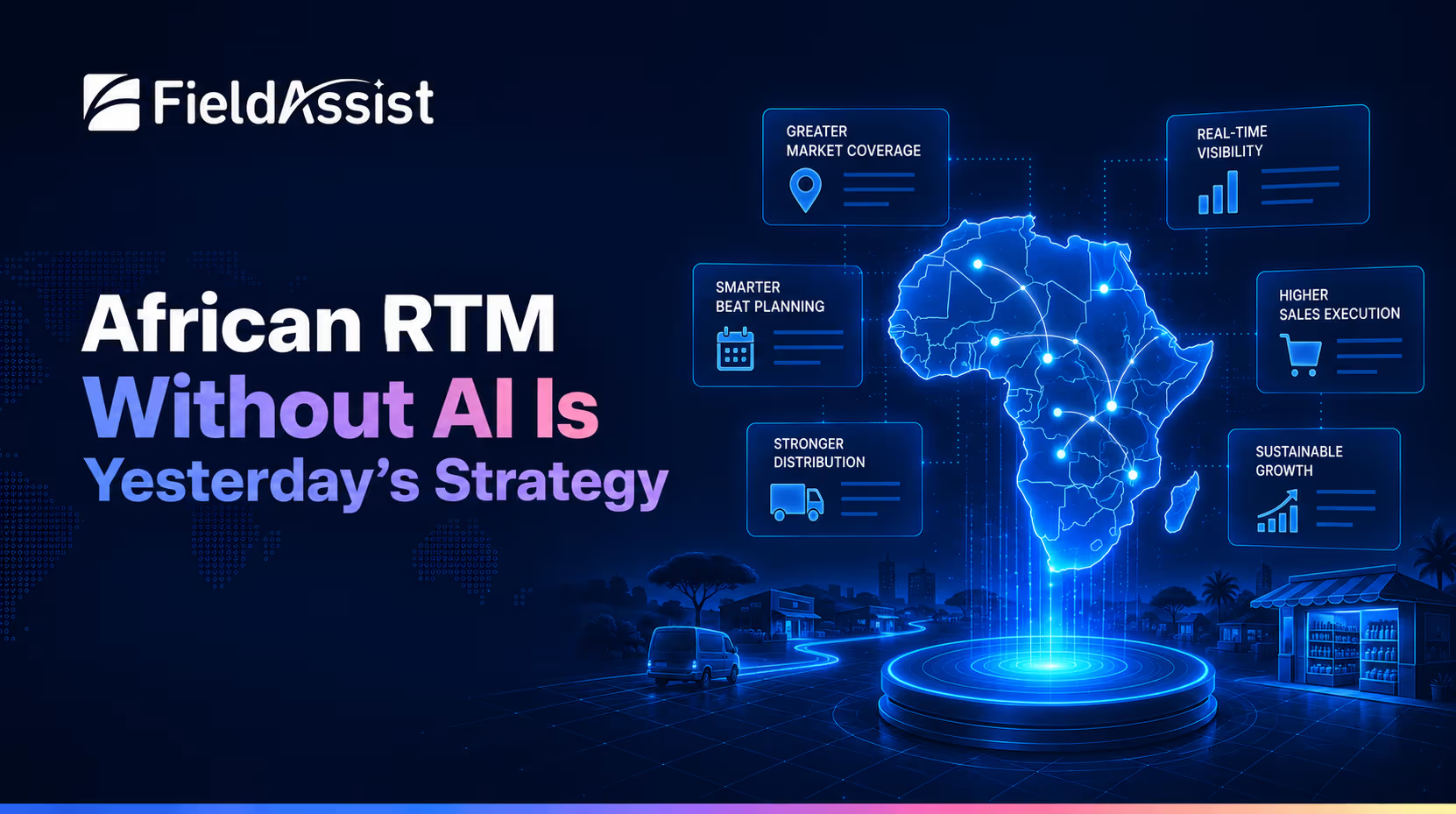
Stop pretending that handing your field reps a basic mobile app is a digital transformation. In the African Fast-Moving Consumer Goods (FMCG) market, traditional Sales Force Automation (SFA) is officially obsolete. If your Route-to-Market (RTM) strategy relies on field teams manually punching orders into a screen while guessing what a retailer might need, you are not digitizing your business; you are just digitizing your inefficiencies.
The African FMCG landscape is at a violent inflection point. Brands continue to bleed margin by copy-pasting Western or standard Asian RTM playbooks into markets like Nigeria, Kenya, and South Africa. They obsess over linear distribution logistics, hoping to force structure onto a market that is inherently, beautifully, and aggressively informal. It does not work. The future of African RTM does not belong to the brands with the most data; it belongs to the brands capable of converting that data into autonomous, intelligent actions at the edge of the network.
The African RTM Reality Nobody Wants to Admit
Industry leaders sit in boardrooms in Lagos, Johannesburg, or London, staring at heat maps and route plans that look perfect on a screen but collapse on the street. Here is the unvarnished truth: African retail is not a monolith, and it is not a linear supply chain. It is a highly networked, hyper-local ecosystem layered with micro-distributors, commission agents, hawkers, and informal wholesalers all operating within a few square kilometers.
In countries like Nigeria, Ghana, and Cameroon, over 90% of FMCG sales still happen through small, local traditional outlets. South Africa alone relies on an estimated 200,000 spaza shops, spazarettes, and midi-wholesalers that service the vast majority of the population. The fundamental error FMCG brands make is equating "informal" with "unstructured." The traditional trade ecosystem is exceptionally structured around trust, credit cycles, and community relationships-it just lacks digital visibility.
Many CPG leaders keep trying the same failed tactics: throwing more human capital at the problem, expanding territories blindly, and treating distribution purely as a logistical challenge rather than a consumer intelligence challenge. They launch massive "retail mapping" exercises that are outdated the moment the data is compiled.
As noted by Boston Consulting Group (BCG), traditional shops will account for 65% to 75% of sales in most of the region through at least 2030. You cannot wait for modern trade to consolidate the market. You have to win in the informal sector, and you cannot win the informal sector with yesterday's passive tools.
The Delusion vs. The Reality
The Intelligence Deficit: Why Passive SFA is Failing
Traditional SFA is a system of record. It tells you what happened yesterday. But in a market where inflation fluctuates, mobile money infrastructure dictates daily purchasing power, and urban density shifts rapidly, knowing what happened yesterday is useless.
When an FMCG sales rep walks into a Duka in Kenya or a Buka in Nigeria, they have roughly three minutes to make an impact. If that rep has to mentally calculate the retailer's past order history, factor in the current trade promotion, check real-time stock availability, and guess which new SKU might sell well, they will default to the path of least resistance: taking the exact same order as last week. This is why FMCG companies in Africa suffer from chronic SKU stagnation. They launch brilliant new products that never make it past the distributor's warehouse because the cognitive load on the field rep is too high.
5 FieldAssist AI Capabilities Rewriting the African Playbook
To dominate the African FMCG space, brands must equip their distribution networks with a cognitive layer. FieldAssist has engineered an FAi suite specifically designed to handle the chaos, fragmentation, and velocity of emerging markets. Here are five features shifting the paradigm from passive data collection to intelligent RTM execution:
1. Pulse AI: The End of Manual Reports and Analytics
- The Hidden Pain Point: Executives only find out about a localized market share drop 30 days later during a monthly review, long after competitors have entrenched themselves on the shelves.
- The Intelligent Fix: Pulse AI acts as an always-on data scientist, scanning millions of data points continuously. It doesn't just present a red chart; it proactively pushes an alert identifying the anomaly and the root cause (e.g., a localized distributor stockout or a competitor's aggressive new pricing scheme).
- The Growth Impact: Leaders shift from reactive firefighting to proactive intervention, plugging revenue leaks in real-time and protecting micro-market share before it bleeds.
2. IRIS: Bringing Perfect Store to the Informal Shelf
- The Hidden Pain Point: Expecting field reps to meticulously count competitor SKUs in a cramped, poorly lit spaza shop is a delusion. The resulting merchandising data is heavily biased, guessed, or entirely fabricated to meet KPIs.
- The Intelligent Fix: IRIS (Image Recognition Intelligence) removes human error. A rep simply points their camera at the chaotic shelf, and the AI instantly digitizes the visual data- detecting product availability, competitor share-of-shelf, and pricing compliance in seconds.
- The Growth Impact: Brands gain an unvarnished, mathematically accurate view of their physical market presence, allowing trade marketing dollars to be spent where visibility actually drives conversion.
3. NOVA: Conversational Agentic AI for Retailers
- The Hidden Pain Point: Brands are structurally blind to the "long tail" of informal retail. The math of fuel costs, traffic, and travel time means human reps simply cannot visit thousands of low-tier kiosks frequently enough to prevent stockouts.
- The Intelligent Fix: NOVA steps in as a conversational AI agent interacting directly with retailers via familiar platforms like WhatsApp. When a human rep cannot visit, NOVA autonomously suggests reorders, introduces new schemes, and secures bookings based on predictive run rates.
- The Growth Impact: Brands scale their effective coverage to 100% of their universe without scaling field headcount, turning passive, unvisited retailers into a continuous, automated revenue stream.
4. ARS (Automated Replenishment System): Killing the Stockout
- The Hidden Pain Point: In Africa, out-of-stock means out-of-mind. The root cause is rarely manufacturing; it is poor working capital management at the micro-distributor level, where cash is trapped in slow-moving inventory while fast-moving SKUs run dry.
- The Intelligent Fix: FieldAssist’s ARS analyzes hyper-local demand velocity and automatically generates precise purchase orders for distributors to maintain optimal inventory liquidity.
- The Growth Impact: By balancing inventory perfectly across the fragmented network, ARS drastically reduces stockouts of hero SKUs, safeguarding brand loyalty and ensuring distributors never miss a sale due to poor capital allocation.
5. Product Recommendations: The Next-Best-Action Engine
- The Hidden Pain Point: FMCG brands suffer chronic SKU stagnation because overwhelmed reps default to selling what is easy. Telling a rep to "cross-sell more" without telling them exactly what to sell is a failed strategy.
- The Intelligent Fix: The AI Product Recommendation engine analyzes historical outlet data, local buying trends, and dynamic clustering to serve explicit Next-Best-Action nudges. It tells the rep exactly which new SKU to pitch and in what quantity.
- The Growth Impact: It mathematically drives up the Order Value per Visit. By removing the cognitive load from the rep, brands finally see successful penetration of new and complementary SKUs deep into the traditional trade.
The Verdict for FMCG Leaders
Africa is not a market you enter to test your operational efficiencies; it is a market that will break operational inefficiencies. The brands that win the next decade will not be those with the largest fleets of vans or the biggest manual sales forces. The winners will be those who embrace Agentic AI and unified data (SFA+DMS) to navigate the informal trade web with unprecedented precision. Moving from passive tools to FieldAssist’s AI-driven intelligence is not an IT upgrade—it is a mandatory survival strategy. The future demands intelligent actions. It is time to stop guessing and start executing.
FAQs
Q: Will AI replace our traditional field sales force in African markets?
No. African retail fundamentally runs on human relationships, community trust, and localized credit. AI is not designed to replace the handshake; it is designed to replace the guesswork. Tools like Pulse AI and Product Recommendations act as an exoskeleton for your sales teams, allowing them to focus on relationship-building and negotiation while the AI handles the cognitive heavy lifting of inventory math and SKU selection.
Q: How does AI functionality hold up in areas with poor internet connectivity?
Modern RTM AI is built with the realities of emerging markets in mind. Critical execution tools (like offline order booking and cached Next-Best-Action recommendations) are designed to function in low-bandwidth environments. Data syncs automatically once the device reaches a stable connection, ensuring that field operations are never halted by infrastructural dead zones.
Q: What is the fastest way to measure the ROI of Agentic AI in our current distribution setup?
FMCG leaders should track three immediate metrics post-deployment: Order Value per Visit (driven by AI cross-selling), Effective Coverage (measuring the reduction in zero-order visits through better predictive routing), and Out-of-Stock reduction at the distributor level (managed by unified SFA+DMS automated replenishment). Improvements in these three areas directly self-fund the technology investment within the first few quarters.




.avif)
.avif)