10 Best Retail Order Management Software Platforms Compared: AI Features, Integrations & Use Cases
A buyer-focused comparison of 10 retail order management platforms by AI features, integrations and use cases, from FMCG distributor workflows to omnichannel retail ordering and reordering.

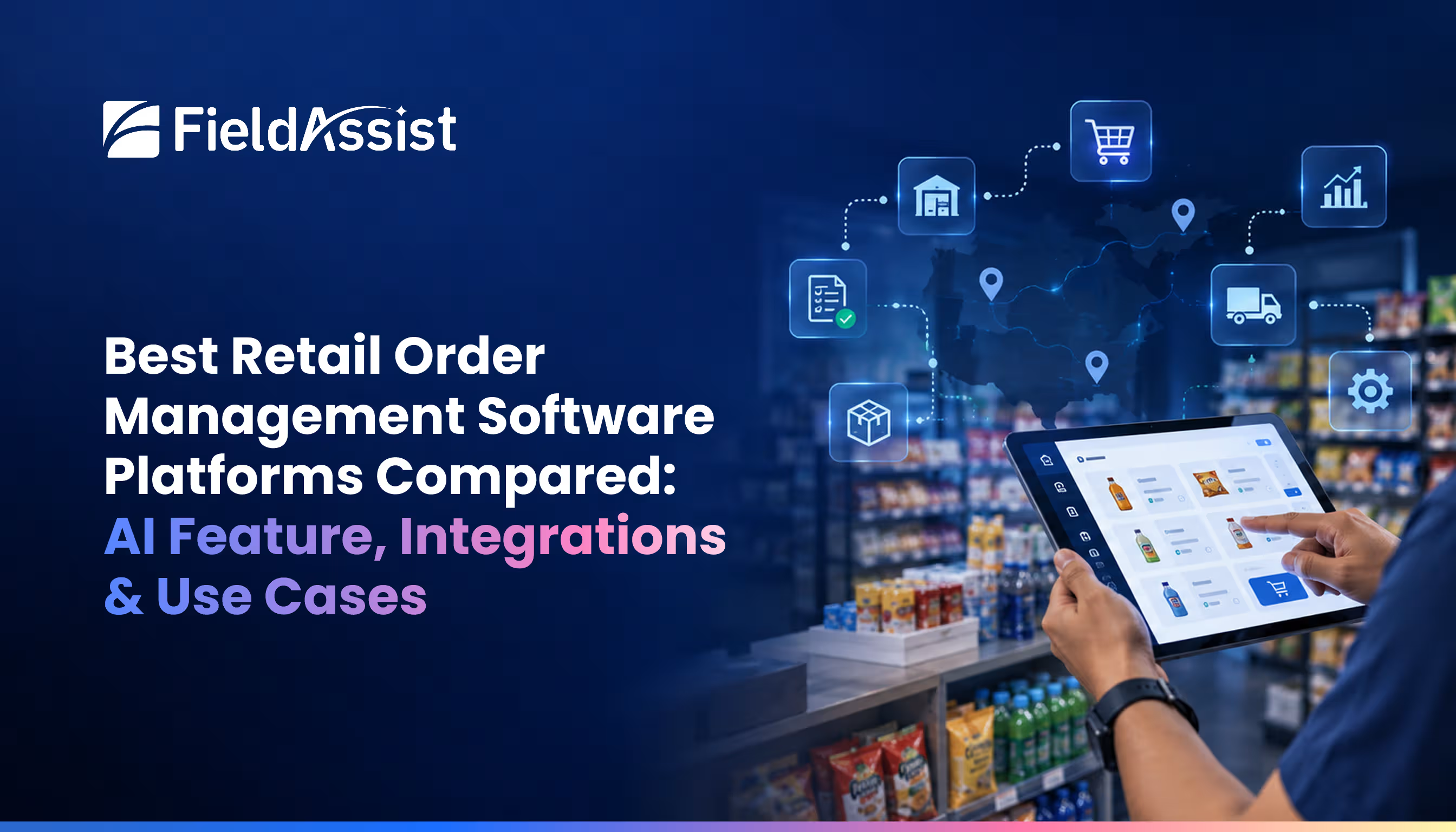
Retail order management software is often treated as an order-entry problem. In distributor-led retail, the harder work starts after an order is captured: checking product availability, applying the right price and scheme, passing the order into distributor workflows, tracking fulfilment, and learning from what was missed. When choosing retail order management software, prioritize how well it connects orders, inventory, fulfilment, and business systems. Avoid platforms that sell AI as a feature but leave critical workflows disconnected.
An intelligent order management system should do more than record transactions. It should help businesses capture demand, reduce operational friction, improve order visibility, and make better decisions across the retail value chain. In this guide, we compare 10 retail order management software platforms by their AI capabilities, integrations, and use cases to help you identify the right fit for your business.
This guide compares 10 platforms by their primary use case, AI capabilities and integration approach. It includes FMCG-focused route-to-market platforms and broader retail OMS products, because those categories solve different problems.
What Is Retail Order Management Software?
Retail order management software helps a business capture, validate, process and track orders from the point of demand through the systems responsible for inventory, billing and fulfilment. Depending on the business model, the order may come from a retailer app, a sales representative, an e-commerce site, a store, a call centre or a distributor portal.
For FMCG and CPG brands, retail order management often connects retailer order capture with sales force automation (SFA), distributor management (DMS), product and pricing data, trade promotions, inventory visibility and ERP processes. A platform may own only part of this workflow, so buyers should verify which system creates the order, which validates availability and pricing, and which controls invoicing and dispatch.
A traditional omnichannel OMS may instead focus on direct-to-consumer orders, fulfilment routing across stores and warehouses, and order administration from placement to shipment. The term “retail order management software” can cover both, but they should not be treated as interchangeable categories.
Which AI Features Are Gaining Momentum in Retail Order Management Software?
The most useful AI features improve a decision inside the order workflow. They do more than summarize sales after the transaction. Buyers should look for the following capabilities, while checking whether they are generally available, separately licensed or still in development.
- Conversational and voice-enabled ordering. Retailers can ask product, scheme or order questions in natural language and place or repeat orders without navigating long catalogues. Have a look at NOVA for agentic ordering.
- Next-best-product and quantity recommendations. The system suggests relevant SKUs, combinations and quantities based on outlet history, availability, buying patterns and business rules.
- Predictive replenishment. Forecasts and stock thresholds can help recommend or generate replenishment orders before inventory gaps become lost sales.
- Promotion and scheme intelligence. Recommendations can surface the offers most relevant to an outlet, while workflow controls help track scheme eligibility and utilization.
- Exception detection and AI agents. AI can flag missed orders, unusual buying patterns, likely stockouts or stalled processes, then recommend a next action. Buyers should check how actions are approved, logged and reversed.
AI is most valuable when the model can work with reliable order, outlet, stock and scheme data. A recommendation engine disconnected from inventory or distributor systems may produce a persuasive suggestion that cannot be fulfilled.
10 Best Retail Order Management Software Platforms (Quick Comparison)
This comparison is organized by primary use case, not by a universal score. Feature availability and integrations can vary by edition, region, implementation and connected systems.
10 Best Retail Order Management Software Platforms – Detailed Comparison
The platforms below cover related but different needs. FieldAssist is discussed first because the strongest fit is the connection between B2B order capture, sales execution, distribution workflows and AI-assisted selling. The remaining profiles describe their product focus without implying that every platform is a direct substitute.
1. FieldAssist: Best Retail Order Management Software in India
For FMCG and CPG brands, the order problem rarely begins and ends with the order form. Demand may surface through a field representative, a retailer app or a distributor interaction. Stock, pricing and scheme rules sit in connected systems, and a submitted order still needs to be processed, billed and fulfilled. FieldAssist is relevant when a brand wants these activities to work as a connected route-to-market workflow rather than as separate sales and distribution tasks.
FieldAssist brings together its eB2B Retailer App, Sales Force Automation (SFA), Distribution Management System (DMS), NOVA, Auto Replenishment System (ARS) and analytics capabilities. Retailers can order through app, progressive web app and WhatsApp-based workflows. Field reps can book orders with outlet and product context. DMS connects relevant inventory, invoicing, schemes and claims processes, while NOVA adds conversational ordering, reorders and outlet-specific product or offer recommendations.
That can change the working experience for each participant. Retailers have a digital route to order without waiting for a visit. Sales reps can spend less time collecting routine orders and more time acting on outlet needs. Distributor teams gain a more connected view of orders, stock and billing. Leaders can use sales and distribution data to investigate missed demand, stockouts and execution gaps.
FieldAssist publishes a 37% reduction in missed orders for NOVA and a 36% reduction in stockouts for ARS. These are vendor-reported results, not guaranteed outcomes; buyers should request the baseline, sample, measurement period and implementation details. FieldAssist also reports a 6% top-line growth result associated with its Nivea partnership, which should be attributed to the broader partnership rather than to order management software alone.
Five USPs of FieldAssist
- Connected B2B order journey. Retailer ordering, SFA and DMS connect demand capture with distributor execution, rather than treating each as a standalone activity.
- AI that helps capture demand. NOVA supports conversational retailer interactions, frequent-SKU reorders, complementary product recommendations and relevant scheme suggestions.
- Order context at the point of sale. FieldAssist SFA can bring stock, pricing, scheme and outlet-history information into the order-booking workflow, helping reps make more informed recommendations.
- Replenishment linked to sales and stock signals. ARS uses forecasts and SKU-level minimum and maximum controls to support replenishment decisions and purchase-order workflows.
- Visibility across the route to market. Connected sales and distribution data can help teams review orders, inventory, claims, promotions and outlet performance across the network.
2. Bizom
Bizom supports order booking, returns, invoice management, stock visibility, trade schemes, and retailer-level execution for FMCG and CPG teams. Its order suggestions use outlet off-take and configurable business rules within daily sales workflows.
3. BeatRoute
BeatRoute combines SFA, DMS, retailer ordering, and AI agents for order capture, tele-ordering, route planning, and retail execution. It suits brands seeking connected field-sales and distribution workflows across distributed sales teams.
4. Botree Software
Botree offers distributor management, sales force automation, retailer self-ordering, inventory and scheme management, plus AI-powered sales recommendations. It is designed for consumer-goods companies managing large distributor networks and secondary sales at scale.
5. Ivy Mobility
Ivy Mobility provides a cloud-based route-to-market platform spanning distributor management, retail execution, and direct-store delivery. It is relevant for consumer-goods companies seeking a unified view across these operating workflows in one system.
6. Channel Konnect
Channel Konnect offers DMS, SFA, order management, schemes, and retailer-management modules. Its DMS Lite connects with distributor billing systems, helping brands access secondary-sales data without forcing partners to replace existing software.
7. Salesforce Consumer Goods Cloud
Salesforce Consumer Goods Cloud supports account planning, promotions, field execution, and direct or indirect order capture. Its broader CRM and AI platform may suit organizations standardizing sales and service workflows.
8. Oracle Retail Order Management Suite
Oracle Retail Order Management Suite focuses on omnichannel order administration and orchestration, including order and inventory data across channels. It is more aligned to enterprise retail fulfilment than distributor-led FMCG execution.
9. Pepperi
Pepperi combines B2B e-commerce, mobile order taking for sales representatives, trade promotions, and direct-store delivery. It suits brands and distributors that want to unify self-service and rep-assisted wholesale ordering across sales channels.
10. SalesDiary
SalesDiary combines field sales automation, distributor management, van sales, order booking, stock and claims workflows, and AI-assisted recommendations. Its platform also highlights offline-first field operations and ERP/SAP connectivity for distribution teams.
How Should Business Leaders Evaluate Retail Order Management Software?
Choose the platform that fixes the most expensive handoff in your current order process. Do not shortlist by AI branding alone. Trace an order from capture to confirmation, invoice and fulfilment, then test whether the software improves the measures your business is accountable for.
Frequently Asked Questions About Retail Order Management Software
1. What is retail order management software?
It captures, validates, processes and tracks orders from the point of demand through inventory, billing and fulfilment workflows. The exact scope depends on whether the business sells through distributors, stores, e-commerce or a mix of channels.
2. How is a retail OMS different from a DMS?
An OMS manages the order lifecycle. A DMS focuses on distributor operations such as orders, inventory, billing, schemes, claims and secondary-sales visibility. In FMCG, the two may work together, but they are not identical.
3. Which AI features matter most in retail order management?
Start with features that change an order decision: conversational ordering, SKU and quantity recommendations, relevant scheme suggestions, predictive replenishment and early detection of missed orders or stock risks. Verify that each feature uses current operational data.
4. Can retail order management software integrate with ERP, SFA and distributor systems?
Many platforms offer integrations, but the systems and depth vary. Ask the vendor to map master data, stock, pricing, orders, invoices, claims and status updates, then demonstrate error handling and reconciliation.
5. What is the best retail order management software for FMCG and CPG brands?
The best fit depends on the route to market. Brands managing retailer orders through field teams and distributors should evaluate platforms that connect order capture, SFA, DMS, trade schemes and replenishment. FieldAssist is one option to assess for that connected B2B use case; omnichannel retailers may need a different OMS architecture.
Strategic Capabilities of FieldAssist’s Retail Order Management Software
FieldAssist’s order-management value comes from the connected capabilities across its product suite, rather than from a single standalone feature. The table below maps each capability to the operational value it can support. Exact availability depends on product, module, integration and implementation scope.
The Bottom Line
Retail order management should be evaluated by how well it turns demand into an order that can be accepted, processed and fulfilled. For distributor-led FMCG and CPG businesses, the meaningful comparison is not just who has an order screen or an AI label. It is whether retailer ordering, field sales, stock, schemes, distributor operations and replenishment work as one dependable process. FieldAssist belongs on that shortlist when that connected route-to-market problem is the priority.