The Blueprint for Growth: Strategies to Accelerate Primary Sales in FMCG
Primary sales in FMCG can be strengthened through demand-driven planning, improved distributor visibility, and data-led strategies that drive consistent growth and reduce inventory gaps.


Imagine this. It’s the last week of the month. A distributor places a bulk order not because retail demand has surged, but because a scheme is ending. The manufacturer celebrates strong primary sales—warehouses are clear of stock. Targets are met.
But two weeks later, the same distributor slows ordering. Retail movement hasn’t kept pace. Inventory sits in the channel.Was that growth or just timing?
Primary sales in FMCG, the movement of goods from manufacturers to distributors directly influence cash flow, production planning, and market readiness. Yet in many organizations, these decisions are still driven by ordering behaviour rather than actual market demand.
The problem becomes even bigger when companies lack data visibility. According to a 2024 Gartner survey of supply-chain leaders, only 29% of organizations have developed the capabilities needed to manage modern supply chain complexity effectively, highlighting a major gap between operational decisions and real demand signals.
When primary sales reflect instinct instead of insight, businesses move from dispatch cycles to demand cycles without realizing the gap in between.
Understanding the Role of Primary Sales in FMCG Growth
Primary sales in FMCG refer to the sale of products from the manufacturer to the distributor. This is the stage where a brand first records its revenue and begins moving products into the market. It acts as the link between production and retail availability.
When primary sales are managed well, they help maintain a steady flow of products across the distribution network. Distributors receive the right SKUs in the right quantities, making it easier for them to supply retailers consistently.
Without a clear strategy for managing primary sales, products may either accumulate in warehouses or fail to reach the market on time. In such cases, even strong marketing campaigns may not translate into actual sales because the product is not available on store shelves when consumers want to buy it.
This gap between supply and retail availability can have a direct impact on consumer behavior. Research highlights that around 50% of consumers switch to another brand if their preferred product is unavailable on the shelf, emphasizing how critical consistent product availability is for consumer goods companies.
Why Strengthening Primary Sales Has Become Increasingly Complex
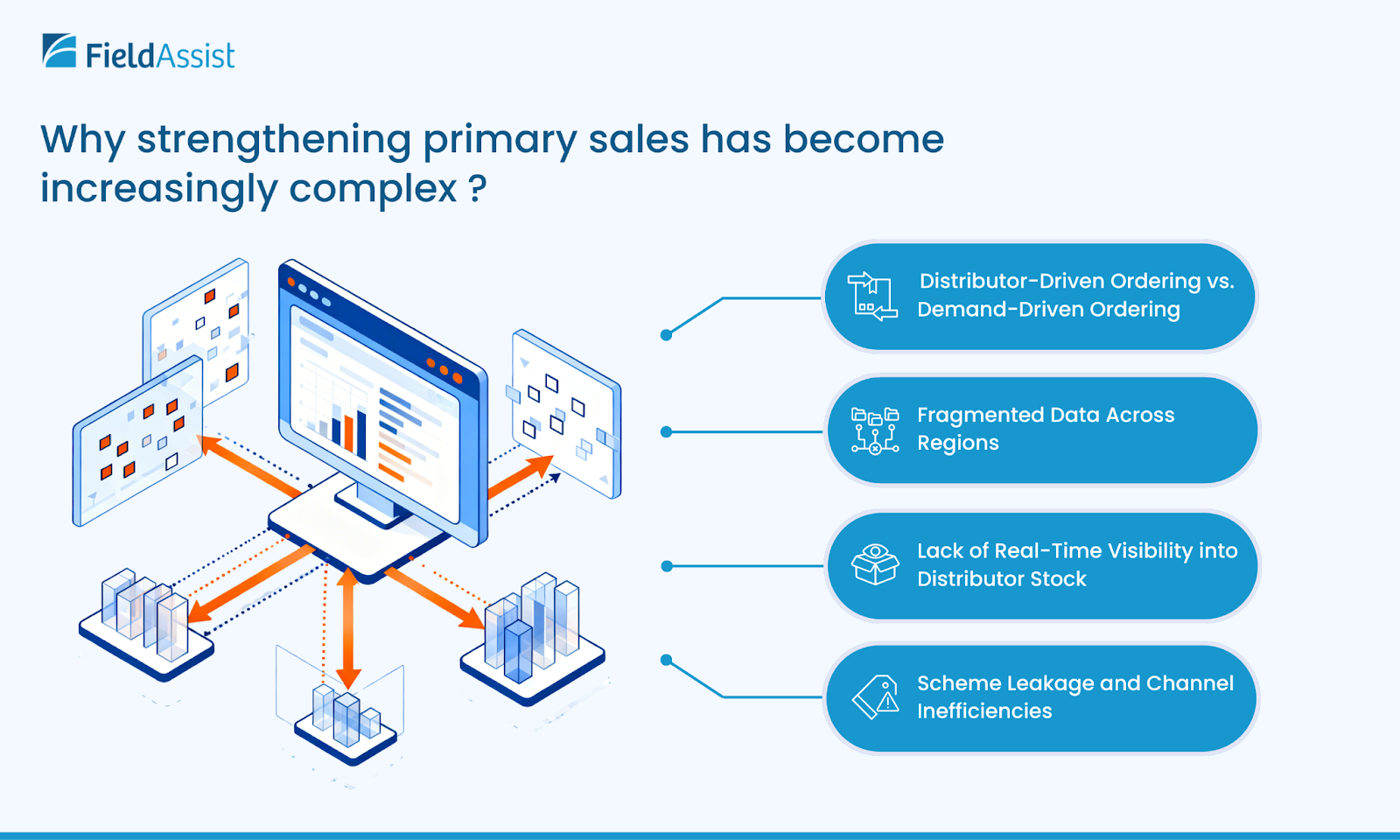
The old way of "pushing" inventory onto distributors is breaking down. As markets get more crowded, managing primary sales strategies in FMCG has become a puzzle with many moving parts.
1. Distributor-Driven Ordering vs. Demand-Driven Ordering
In many traditional setups, distributor orders are based on habit, intuition, or schemes rather than actual consumer demand. This often creates a gap between what is stocked in warehouses and what the market actually needs.
For instance, a beverage distributor may continue ordering the same volume of diet soda every summer based on past patterns, even when consumer demand has shifted toward zero-sugar juice. As a result, slow-moving stock builds up while high-demand products run out in retail stores.
2. Fragmented Data Across Regions
Large FMCG companies often operate with different reporting systems across regions. When data is scattered across spreadsheets, legacy systems, or manual updates, it becomes difficult to get a clear national view of demand. For example, when planning a national promotion, companies may take weeks to compile distributor stock data from different regions, delaying important decisions.
3. Lack of Real-Time Visibility into Distributor Stock
Many FMCG brands lose visibility once products leave the factory. Without real-time insights into distributor inventory, companies often rely on delayed information when planning dispatch.
A snack company launching a new chip flavor may receive repeat orders and assume demand is strong, while earlier stock remains unsold in the distributor’s warehouse, leading to excess inventory in the channel
4. Scheme Leakage and Channel Inefficiencies
Trade schemes are meant to increase product movement in the market. However, when they are not properly tracked, distributors may buy extra stock only to avail the discount instead of pushing it to retailers. This leads to a temporary increase in primary sales but slower movement in the following months.
Core Strategies to Improve Primary Sales Performance
Improving primary sales requires FMCG brands to move beyond target-driven dispatch and adopt a more structured approach to managing distributor operations. With the help of digital platforms like FieldAssist, companies can gain better control over distributor activity, improve visibility across the channel, and make more informed primary sales decisions.
The following strategies outline how brands can build a stronger and more consistent primary sales engine.
1. Shift from Push-Based to Demand-Led Planning
Many companies still push inventory to distributors based on targets or schemes. However, this approach often leads to excess stock in warehouses while retailers run out of fast-moving products.
Instead, brands should plan primary sales based on actual market signals such as secondary sales data, seasonal demand, and regional consumption trends. When dispatch decisions are based on real demand, distributors receive the right products at the right time, reducing unsold inventory and improving product availability in the market.
Research from McKinsey shows that advanced analytics and digital supply chain tools can reduce forecasting errors by 30–50%, enabling more accurate planning of production and distribution.
2. Improve Distributor Visibility
Primary sales become difficult to manage when brands lack visibility into distributor operations. According to Deloitte’s 2025 Smart Manufacturing Survey, 48% of manufacturers still face significant challenges in operations management roles, often due to a lack of integrated tools.
With a Distributor Management System like FieldAssist, brands close this gap by gaining real-time visibility into distributor inventory, helping sales teams identify stock imbalances before they hit the retail shelf.
3. Enable Data-Driven Order Recommendations
Distributors often rely on past experience or intuition when deciding how much stock to order. As product portfolios grow and demand becomes more dynamic, this approach can lead to either overstocking or stock shortages.
Using historical sales data and demand patterns, systems like FieldAssist can generate intelligent order recommendations for distributors. These suggestions help distributors maintain balanced inventory levels while ensuring high-demand products are always available in the market.
4. Standardize Distributor Ordering Cycles
Unstructured ordering patterns can create operational challenges. When distributors place orders randomly or only at month-end, it becomes difficult for manufacturers to plan production and logistics efficiently.
Setting clear ordering cycles, such as weekly or bi-weekly ordering windows, creates more consistency. With predictable order patterns, companies can plan manufacturing, warehouse operations, and delivery schedules more efficiently, reducing supply disruptions.
5. Align Trade Schemes with Market Movement
Trade schemes are often used to boost primary sales, but poorly targeted promotions can lead to stock loading rather than real market growth.
When brands analyze market performance data, they can design schemes that encourage distributors to replenish products that are actually moving in the market. With FieldAssist, companies can track scheme performance across distributors and regions, helping ensure that promotional investments translate into genuine retail movement.
6. Strengthen Distributor Engagement Through Digital Tools
Distributors are key partners in the FMCG value chain, and strong collaboration plays a major role in maintaining consistent primary sales. Providing distributors with simple digital tools improves transparency and communication.
This makes the ordering process more convenient while strengthening distributor engagement with the brand.
Business Impact of Primary Sales Improvement
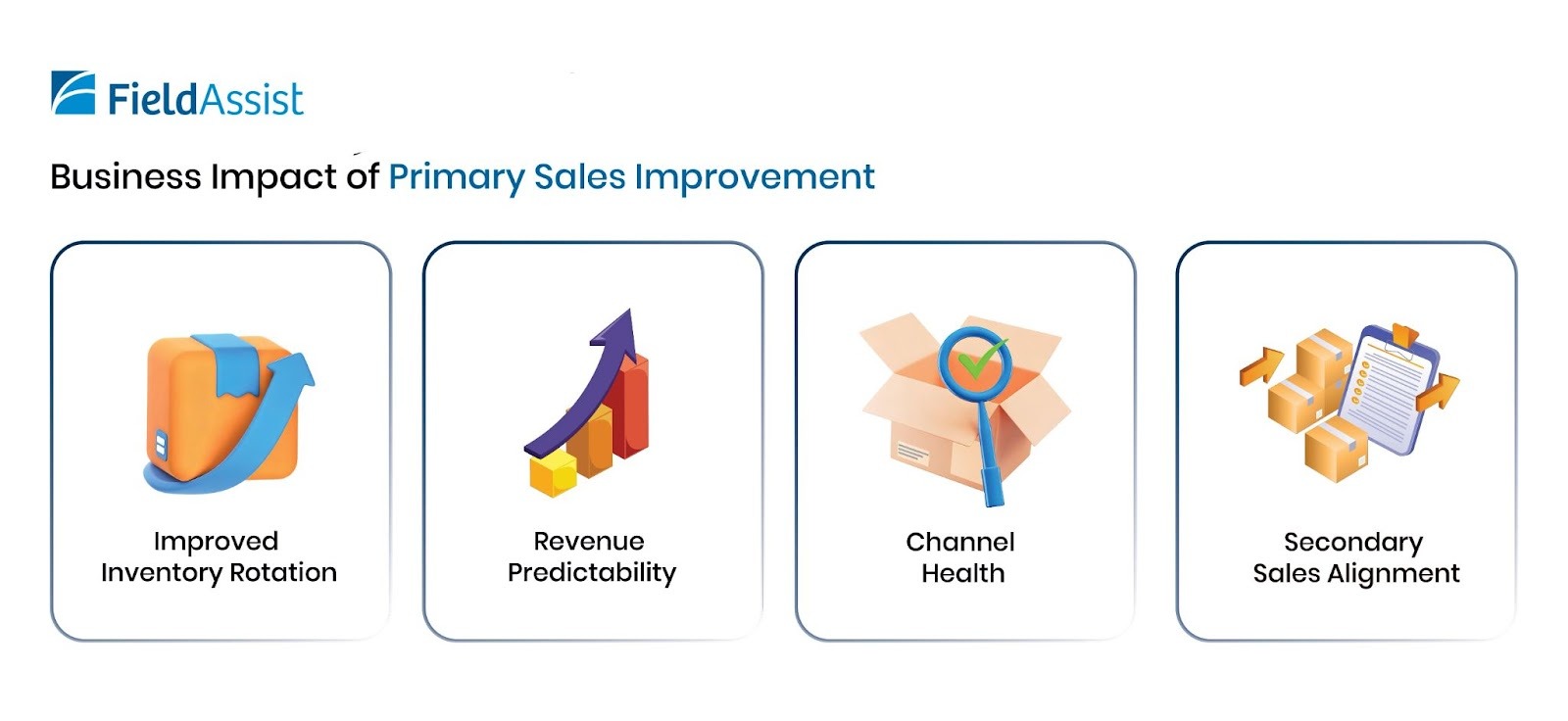
Improving primary sales processes helps FMCG brands create a more stable and efficient distribution system. When primary movement is aligned with actual market demand, it leads to better inventory control, more predictable revenue, and smoother market execution.
Closing Thoughts: Creating a Sustainable Growth Loop
The "Blueprint for Growth" is about creating a cycle where Visibility leads to Insights, and Insights lead to better Execution. By mastering your primary sales in FMCG, you move away from "guessing" and toward "knowing."
When you combine demand forecasting in FMCG with modern distributor management for FMCG, you build a business that is faster, leaner, and ready to win.
Would you like to see how we can transform your Primary Sales? Click here to learn more.



%20(1).avif)