Why Disconnected Systems Are Silently Draining FMCG Profits in Africa's Informal Trade Markets
Disconnected systems lead to stockouts, data errors, and revenue leakage in Nigeria’s FMCG trade. iPaaS in Africa connects sales, inventory, and finance systems to improve visibility, reduce losses, and enable faster decisions.

There’s a crisis happening in Nigeria’s FMCG sector, and most boardrooms can’t see it. It doesn’t show up as a line item in the P&L. It doesn’t trigger an audit. It doesn’t get escalated in the weekly sales review. But every quarter, it quietly bleeds revenue, erodes margins, and compounds into a strategic disadvantage that no amount of market expansion can cure.
The culprit? Disconnected systems. And in Nigeria, Africa’s largest, most complex, and most fragmented consumer market, the damage runs deeper than almost anywhere else on the continent.
Nigeria's Informal Trade Reality
Nigeria’s wholesale and retail trade contributes approximately 16% to GDP, mostly through informal channels- according to McKinsey’s analysis of Nigeria’s retail economy. Traditional open-air markets account for 72% of retail food sales, while supermarkets capture just 3%, as per USDA FAS data. Oxford Business Group notes that informal sales channels account for 90% of all retail activity in Nigeria.
Informal retail dominates consumer goods distribution across sub-Saharan Africa, with Nigeria leading in scale due to its population size and urban density. This means brands don’t just participate in informal trade; they depend on it.
Yet, this channel operates with:
- Limited digital infrastructure
- Multi-layered distribution (super-stockists, distributors, sub-stockists, retailers)
- Heavy reliance on manual processes
In Nigeria, where the "Open Market" (like Lagos’s Balogun or Kano’s Singer Market) drives the bulk of volume, a lack of an iPaaS Platform in Africa means brands are essentially flying blind in their most critical territories.
What Nigerian FMCG Brands Are Actually Losing Without an iPaas Software in Africa
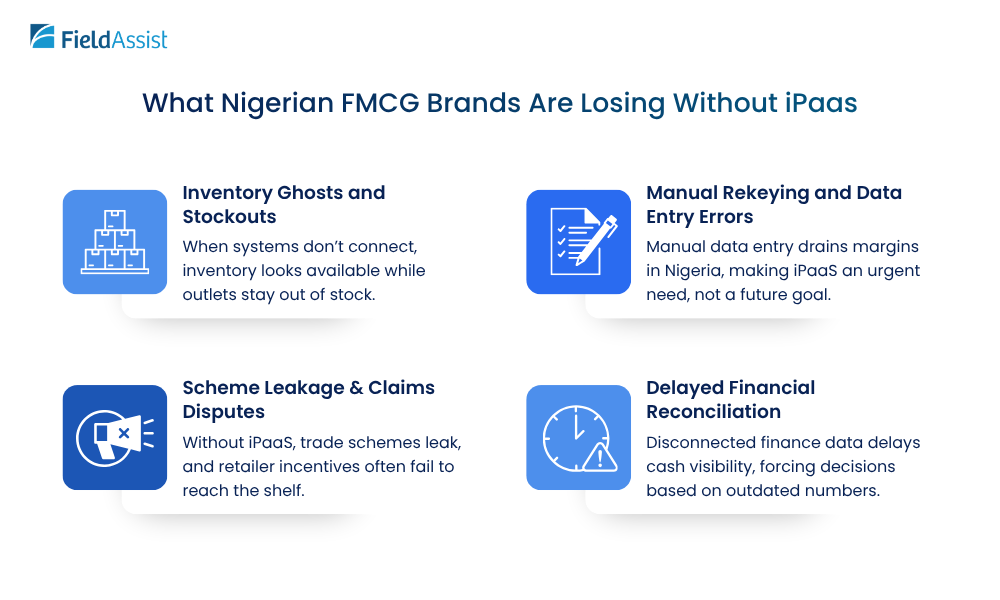
1. Inventory Ghosts and Stockouts
When systems don’t communicate, inventory data lies. Without a unified Integration Platform in Nigeria, a distributor’s system may show stock available in Lagos, while a sub-stockist in Ibadan has been out of stock for days.
2. Manual Rekeying and Data Entry Errors
Across Nigeria’s distributor landscape, orders are placed on WhatsApp, inventory tracked in Excel, and field data transcribed manually into ERPs hours later. Industry report estimates poor data quality costs organizations $12.9 million annually.
In Nigeria, where trade margins are already squeezed by inflation and naira depreciation, the case for iPaaS Companies in Africa to eliminate manual rekeying is urgent, not aspirational.
3. Scheme Leakage and Claims Disputes
Trade promotions are a staple of Nigerian retail. However, without an Enterprise Integration Platform as a Service in Nigeria, verifying if a "Buy 10, Get 1 Free" scheme reached a retailer in Onitsha becomes a nightmare. Brands lose millions annually to "scheme leakage," where incentives are claimed by intermediaries but never passed to the retail point.
4. Delayed Financial Reconciliation
With production costs up 67% in early 2024 and food prices rising sharply, managing cash flow has become critical, according to NielsenIQ and USDA Foreign Agricultural Service.
In this situation, businesses need accurate, real-time financial data to make the right decisions. But when distributor records, payments, and ERP systems are not connected, it takes weeks to match and verify data. This delay creates confusion around actual cash flow, making companies rely on outdated information and leading to poor or delayed business decisions.
Why Nigeria Makes This Problem Worse Than Most Markets?
- Infrastructure Realities
Frequent power outages and inconsistent 4G/5G penetration mean that data syncs are often interrupted. A standard global integration might fail, but a localized solution handles "offline-first" synchronization gracefully.
Any Integration Platform as a Service in Africa deployed here must be built for offline-first operation and lightweight data transmission, not enterprise infrastructure assumptions from mature markets.
- A Highly Fragmented Distributor Ecosystem
A mid-size Nigerian FMCG brand might work with primary distributors running SAP, regional wholesalers on locally built DMS tools, and micro-distributors using notebooks. In markets like Onitsha, informal networks bypass appointed distributors entirely, generating zero data.
This fragmented reality, and not the complexity of the technology, is the core challenge that iPaaS Companies in Africa must solve.
- High Turnover in Field Sales
The Nigerian field sales force is dynamic but has high turnover. When systems are disconnected, the "tribal knowledge" of a departing sales rep (who owes what, which shops are growing) disappears. Integration ensures the data stays with the brand, not the individual.
Enter FAIS iPaaS- Integration That's Built for the Chaos of Nigerian Trade
As per reports, the global iPaaS market exceeded $9 billion in 2024, growing from $7.8 billion in 2023, with forecasts pointing beyond $17 billion by 2028. FieldAssist’s FAIS iPaaS is an Integration Platform purpose-built for Nigeria’s operating realities, not adapted from a mature-market template.
1. Cross-DMS Compatibility for Nigeria's Mixed Ecosystem
Nigeria's distributor landscape runs on a patchwork of systems: SAP, Oracle, Tally, NexSoft, FlexNote, and often nothing structured at all. FAIS connects all of them out of the box, using pre-built connectors and reusable workflow templates that eliminate custom coding at every distributor onboarding.
Build an integration once, replicate it across every distributor in Lagos, Kano, or Port Harcourt without writing a single line of new code.
2. Smart Logs and Monitoring for Field Accountability
Every field visit is timestamped. Every order is validated at the point of capture. Every scheme activation is logged. When a discrepancy appears, the audit trail exists. This transforms the data environment from reactive to proactive, flagging leakages before they compound.
3. Scalable for Nigeria's Growth Ambitions
Already deployed across India, MENA, and Southeast Asia, FAIS is built for the scale Nigerian FMCG brands are chasing. Whether integrating 10 distributors in Lagos or rolling out across 200 points spanning six geopolitical zones, the architecture holds- no rebuilds, no slowdowns.
It also supports AI integration scenarios, meaning the data infrastructure you build today feeds smarter forecasting and field analytics tomorrow.
What Changes When Systems Actually Talk to Each Other?
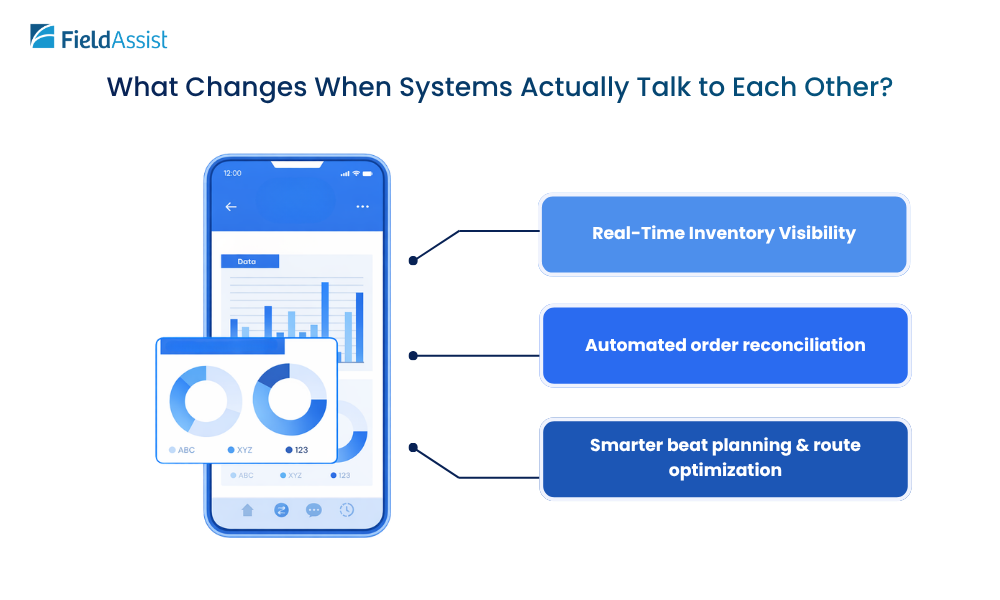
- Real-Time Inventory Visibility
Live stock data across every distribution node means a Lagos sales manager can spot a Kano stockout 48 hours early and trigger replenishment before the shelf goes empty. Connected distribution tools have been shown to reduce inventory levels by 35% and lift service performance by up to 65%.
- Automated order reconciliation
Every order, scheme claim, and payment flows into a single reconciled record, automatically validated, matched, and closed. When the field app and the warehouse system are integrated, every bag of flour or crate of soda is tracked. Automation reduces the reconciliation cycle from 30 days to 24 hours.
- Smarter beat planning and route optimization
When sales, visit, and inventory data are connected, beat planning becomes smarter and more dynamic. Instead of following fixed routes, sales reps focus on high-priority outlets—stores that need stock or drive more sales.
This means fewer wasted visits and better use of time. This data-driven approach can deliver 10–15% sales improvements in African consumer goods markets.
Closing Thoughts- Profit Is Hiding in Your Data, Not in New Markets
With 54.1% value growth in 2025 and a $25 billion market, Nigeria’s FMCG opportunity is undeniable. But the brands that capture it won’t do so by chasing new geographies or launching new SKUs. They’ll do it by fixing the foundational problem most of their competitors are ignoring: the cost of disconnection.
Every stockout that goes undetected is a lost sale. Every manual rekeying error corrupts a decision downstream. Every unresolved claim dispute weakens a distributor relationship. Every week of delayed reconciliation is a week of strategic blindness.
The profit is already there. You just can’t see it yet because your systems aren’t talking to each other. FieldAssist iPaaS in Africa is built specifically for the realities of Nigerian trade. It is the present-day mechanism through which you stop losing what you’ve already earned.



%20(1).avif)