Why Outlet Data Sanitization is the Key to Africa's FMCG 2X Growth?
Duplicated or obsolete outlet data means wasted reachout efforts, trade spend, and blind spots. That’s why outlet data sanitization software is the strategic key to dominating Africa’s FMCG trade sector.

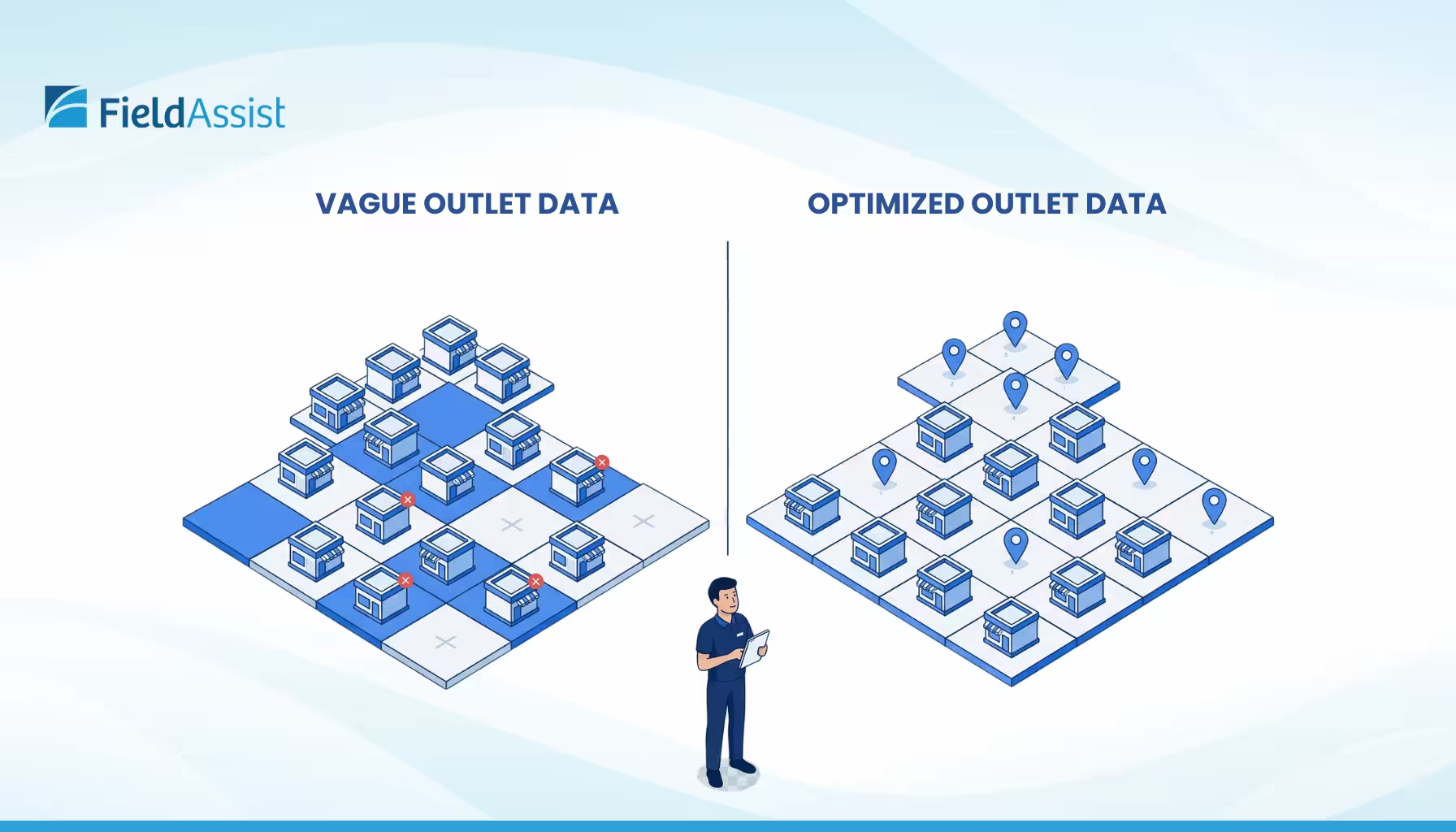
What happens when your most expensive sales software sends a top-performing rep to a store that no longer exists?
Imagine the daily reality for your field team. A rep battles heavy traffic, navigates a crowded informal market, and finally reaches the pinned location - only to find the shop permanently closed, or the owner says another rep just took their order under a completely different store name. Situations like this kill their momentum, waste valuable time, and destroy their trust in the very SFA app meant to help them sell.
For business leaders, this daily frustration in the field translates into a massive, silent profit leak. Your Sales Force Automation (SFA) and Distributor Management Systems (DMS) are designed to work in perfect harmony, but that synergy is likely to fail without strict outlet data sanitization.
If your database is cluttered with duplicate entries and obsolete shop attributes, your SFA and DMS cannot communicate. Orders get lost, trade promotions are wasted on the same store twice, and your market coverage reports become pure fiction.
Thus, you have to fix the foundation first. Clean, sanitized outlet data is the non-negotiable starting point for stopping the financial bleeding, empowering your field force, and making your distribution network truly unstoppable.
What is Outlet Data Sanitization?
Outlet data sanitization is the systematic process of cleaning, validating, standardizing, and deduplicating a retail company's outlet master database, also known as the outlet universe. Its primary purpose is to optimize cost-to-serve by preventing waste of time, fuel, and resources in dead zones or at inactive store coordinates.
In the FMCG sector, outlet data sanitization ensures that every physical retail touchpoint, from modern supermarkets to informal trade kiosks, is accurately represented with a single, verified digital identity.
The Core Pillars of Outlet Data Sanitization
1. Algorithmic Deduplication: Utilizing intelligent matching and algorithms to identify and merge overlapping records. This resolves data fragmentation where a single physical store is logged under multiple naming conventions or phonetic variations.
2. OTP-Based Identity Validation: Replacing traditional, easily manipulated geospatial checks with direct telecommunication verification. By mandating that a One-Time Password (OTP) be sent to the retailer's registered mobile device during onboarding or order generation, the system verifies the outlet's active status. This immediately prevents field reps from creating fake stores and establishes a verified, direct-to-retailer communication channel.
3. Attribute Standardization: Normalizing outlet metadata - such as channel classification, store format, tax identification numbers, and distributor mapping - to ensure uniformity across the entire enterprise ecosystem.
4. Lifecycle Flagging: Implementing automated rules to identify, quarantine, and purge "ghost outlets" (permanently closed or inactive storefronts) to maintain continuous database hygiene and prevent the inflation of effective coverage metrics.
What are the Most Common Outlet Data Issues in Africa?
The main challenge in Africa’s FMCG is not the absence of data. It is the quality and reliability of the outlet master itself. Retail networks expand quickly, distributor structures vary across regions, and field teams often create new outlet records during daily visits. Over time, this leads to fragmented and inconsistent outlet databases.
Below are some of the most common outlet data issues brands encounter while operating in African markets.
1. Duplicate Outlet Records
One of the most widespread issues is the presence of multiple records for the same retailer. Different sales representatives or distributors may create separate entries for the same shop due to spelling variations, missing addresses, or inconsistent naming conventions.
For example, a retailer like “Mama Grace Kiosk” could appear as:
- Mama Grace Shop
- Grace Kiosk
- Mama Grace Store
These duplicate records inflate the outlet universe and distort coverage metrics.
2. Ghost or Inactive Outlets
Many outlet lists include retailers that are no longer active or have permanently closed. However, these outlets remain in the system because they were never removed or verified again.
This leads to:
- false coverage reporting
- wasted field visits
- inaccurate territory planning
Sales teams often spend time attempting to service outlets that no longer exist.
3. Incorrect or Missing Geolocation Data
Accurate location data is essential for route planning and territory optimization. Yet in many cases, outlet coordinates are either missing, incorrectly captured, or manually approximated.
Common problems include:
- Location captured far from the actual store
- coordinates recorded at distributor warehouses instead of the outlet
- locations missing entirely
Without current location data, route optimization becomes extremely difficult.
4. Misclassified Retail Channels
Retail formats in Africa are diverse and often informal. Small kiosks, roadside vendors, mini-markets, and wholesalers frequently get incorrectly categorized in the system.
For example:
- kiosks recorded as wholesalers
- small shops labeled as supermarkets
- mixed-use outlets are categorized inconsistently
This misclassification impacts:
- assortment planning
- trade schemes
- channel-specific sales strategies.
5. Distributor-Level Data Silos
In many cases, each distributor maintains its own outlet database. When brands operate across multiple distributors, the same retailer may exist in several systems with different details.
The result is a fragmented view of the market where:
- outlet lists cannot be easily consolidated
- duplicates multiply across regions
- secondary sales visibility becomes unreliable.
6. Incomplete Outlet Profiles
Even when outlets exist in the database, critical information is often missing.
Typical gaps include:
- missing phone numbers
- incomplete addresses
- unknown ownership details
- absent channel classification
Incomplete records make it harder for brands to execute targeted trade programs or retailer engagement initiatives.
Why is Outlet Data Sanitization a Critical Growth Lever for FMCG Brands in Africa?
If you’re an FMCG brand operating in Africa, outlet data sanitization is the foundational requirement for Sales and Distribution (S&D) profitability. Because 70% to 80% of Africa's retail volume flows through highly fragmented, unmapped informal trade (such as dukas, spaza shops, and open-market vendors), and possessing a bloated or inaccurate outlet master database actively destroys profit margins and paralyzes enterprise technology.
When the outlet master is unreliable, every downstream activity, from route planning to sales analytics, starts from an inaccurate foundation.
Rigorous data sanitization is critical for African FMCG brands for six strategic reasons:
1. Defines the True Size of the Market
Outlet data sanitization helps brands identify real active outlets, remove duplication, and helps in establishing accurate outlet universe. This level of clarity answers a fundamental question: How many outlets actually exist, and how many are we truly serving?
2. Unlocks Route-to-Market (RTM) Efficiency
When outlet data is inaccurate, field routes become highly inefficient. Your reps will visit duplicate or inactive outlets, and high-potential outlets are missed. Sanitized outlet data enables optimized beat plans, better territory alignment, and high productivity per sales rep.
3. Strengthens Secondary Sales Visibility
With clean outlet data, chances of sales data getting duplicated become near-zero. Secondary sales reporting becomes accurate when sales are mapped to the correct retailer and analytics shifts from reactive to predictive. This is critical for brands aiming to build data-driven distribution systems.
4. It Builds SFA and DMS Synergy
A proper outlet data sanitization ensures that every order punched by a rep in a mobile Sales Force Automation (SFA) app maps flawlessly to the correct ledger in the Distributor Management System (DMS). Thus, preventing orphaned orders and ensuring that performance across regions is meaningful.
5. Targeted Execution at the Outlet Level
Growth in FMCG increasingly depends on precision execution, not just scale. To drive the right outcomes, brands need to know: (a) which outlets to prioritize, (b) what assortment to push, and (c) which schemes to apply. This is only possible when outlet data is complete and correctly classified. Sanitization allows brands to identify high-potential outlets, tailor execution strategies by channel and geography, and improve conversion at the point of sale.
6. Foundation for AI and Advanced Analytics
Modern capabilities like route optimization, demand forecasting, retail intelligence, stock replenishment, and AI-driven recommendations - all depend on structured and accurate data. If the outlet layer is flawed, these systems produce flawed outputs. So clean data is a multiplier of every downstream capability.
Benefits of Outlet Data Sanitization Across SFA and DMS
Stop navigating Africa's retail landscape with a broken map. If you can’t trust your outlet universe, you can’t trust your revenue projections. Don't let ghost stores and duplicate outlet entries drain your trade spend and derail your 2X growth mandate.
To know more about how FieldAssist is helping top CPG brands across Africa clean their data, capture hidden shelf space, and dominate the micro-market, request a demo.