The Integrated Enterprise: Re-architecting FMCG Sales for 2026 and Beyond


The Changing FMCG Sales Reality in 2026
The street-level reality of FMCG sales has fundamentally evolved. Brands are no longer operating through linear, store-only models but across a connected ecosystem of traditional trade, modern retail, and rapidly growing digital channels. This shift has increased operational complexity, with multiple touchpoints demanding better visibility, speed, and coordination.
In markets like Southeast Asia and Africa, traditional trade still drives volume, but rising modern retail and rural demand are reshaping the landscape. Being “omnichannel” is now a baseline expectation. Any mismatch between sales data, distributor inventory, and real demand directly leads to revenue loss and inefficiencies.
This shift is also changing the power dynamics within the ecosystem. According to Deloitte’s 2026 Global Consumer Products Industry Outlook, 79% of consumer product executives expect power to move further toward retailers, driven by their stronger control over consumer data.
At the same time, quick commerce and social commerce are redefining speed, with retailers now expecting much faster fulfillment and near-instant restocking similar to 10-minute delivery models. However, without a unified SaaS integration platform, different systems like inventory, sales, and warehousing operate in silos, leading to stock imbalances, missed sales opportunities, and a poor customer experience.
What Does an Integrated Sales Ecosystem Look Like in Action?
An integrated sales ecosystem is not simply a collection of software tools. It is a unified architecture where every component of the sales and distribution value chain, from field sales force automation (SFA) and distributor management systems (DMS) to ERP, CRM, supply chain, and trade marketing, operates on a single, interconnected data backbone.
Think of it as a living organism. The SFA app on a field rep's phone, the DMS portal a distributor logs into, the ERP system generating invoices, and the analytics dashboard a sales director reviews, all of these should speak the same language, at the same time, without manual intervention. This is what a true enterprise integration platform delivers: a connected, intelligent, and automated sales nervous system.
In practical terms, an integrated ecosystem eliminates the "last mile data gap" , the point where information collected in the field dies in spreadsheets or isolated databases before it can inform strategic decisions. The result is a sales operation that is faster, leaner, and significantly more profitable.
How Fragmented Systems Are Slowing Down FMCG Sales?
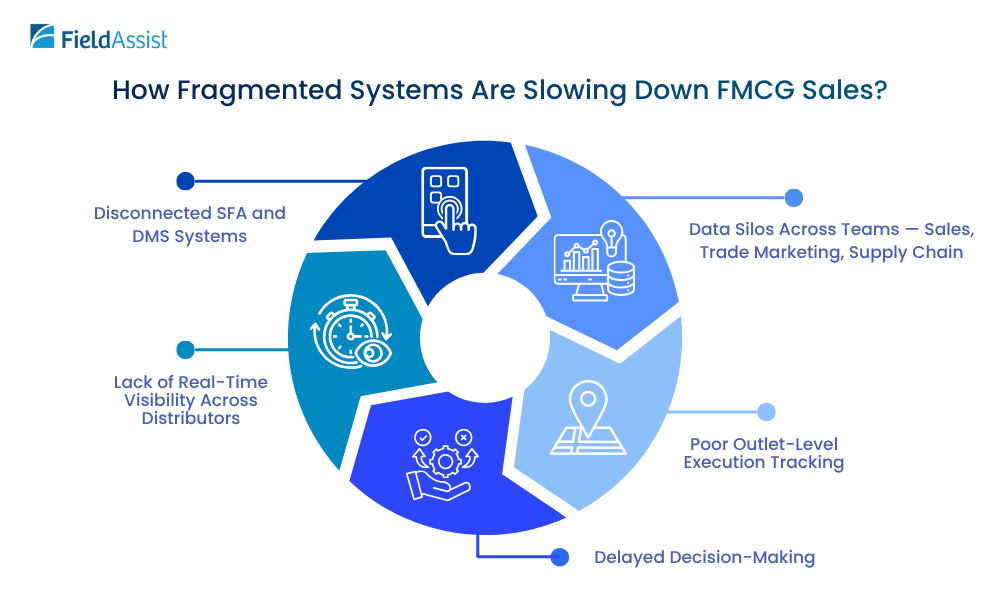
Despite the urgency, most FMCG brands in 2026 still run fragmented operations. Individual teams use individual tools, and the integration between them if it exists at all, is manual, error-prone, and delayed. Here is how these fractures manifest across the business:
1. Disconnected SFA and DMS Systems
Sales force automation tools track field activities while Distributor management systems track secondary sales, inventory, and claims. But when these two systems operate independently, critical visibility is lost.
A stockout at a distributor may not be visible to the field rep serving that territory until it is too late. The absence of B2B integration software between SFA and DMS is one of the most common and costly gaps in FMCG sales infrastructure.
2. Lack of Real-Time Visibility Across Distributors
Most brands rely on distributors submitting data periodically, daily at best, weekly at worst. By the time this data is reviewed, market conditions have already changed.
FieldAssist’s FAIS iPaaS addresses this gap by enabling real-time data sync across SFA, DMS, ERP, and distributor systems—eliminating manual data handoffs, reducing errors, and providing end-to-end visibility across the sales ecosystem.
3. Data Silos Across Teams — Sales, Trade Marketing, Supply Chain
Sales teams are chasing volume. Trade marketing teams are planning promotions. Supply chain teams are managing replenishment. When each team works with a different data set from a different system, conflicts and inefficiencies are inevitable. A trade promotion gets launched without supply chain alignment, causing a sudden stockout at the moment of peak demand. These costly misalignments are a direct consequence of missing SaaS integration platform capabilities.
4. Poor Outlet-Level Execution Tracking
FMCG success is won or lost at the outlet level. Whether a product is placed on the eye-level shelf, whether the promotional display is set up correctly, whether a competitor has taken over shelf space, all of this matters enormously to sales outcomes. Without integrated retail execution tools connected to the broader sales ecosystem, brands have no reliable way to monitor or improve outlet-level execution at scale.
5. Delayed Decision-Making
When data from the field takes 24 - 48 hours to reach management, the window for corrective action shrinks dramatically. In a Q-commerce environment where consumer demand spikes last hours, not days, delayed decision-making is not just inefficient — it is existential. An integration platform enables real-time data flow, shrinking the gap between an event happening in the market and a decision being made at headquarters.
The High Cost of Siloed Sales Operations
The financial cost of disconnected sales systems is staggering and quantifiable. A Forrester report on digital operations found that companies operating with siloed sales technology waste up to 20–30% of their sales capacity due to inefficiencies that a unified enterprise integration platform could eliminate. Here is where the damage accumulates:
- Lost Sales Due to Stockouts
Stockouts are the silent revenue killers of FMCG. When a product is unavailable at the time a consumer seeks it, the sale is lost — and increasingly, so is the customer. Integrated inventory visibility across the distributor and retail network is the only reliable prevention.
- Poor On-Shelf Availability (OSA)
On-shelf availability directly drives revenue. Without a real-time connection between field data and supply chain decisions, brands cannot identify and correct OSA failures fast enough to prevent revenue loss.
- Inefficient Distributor Coordination
Distributor relationships are the lifeblood of the FMCG scale. But without B2B integration software connecting brand systems to distributor workflows, coordination becomes reactive. Distributors receive late replenishment signals, process claims manually, and operate with limited visibility into the brand's promotional plans — leading to under-stocking, over-stocking, and missed sales windows.
- Low Field Productivity
Field sales representatives spend a disproportionate amount of time on administrative tasks — filling out paper forms, manually recording outlet data, and reconciling information across disparate apps. A SaaS integration platform that automates data capture and syncs it instantly can reclaim this productive time and direct it toward revenue-generating activities.
- Inaccurate Demand Forecasting
Demand forecasting accuracy is directly correlated with data quality and data recency. Siloed systems produce stale, incomplete data — and stale data produces inaccurate forecasts.
How FMCG Brands Can Build an Integrated Sales Ecosystem?
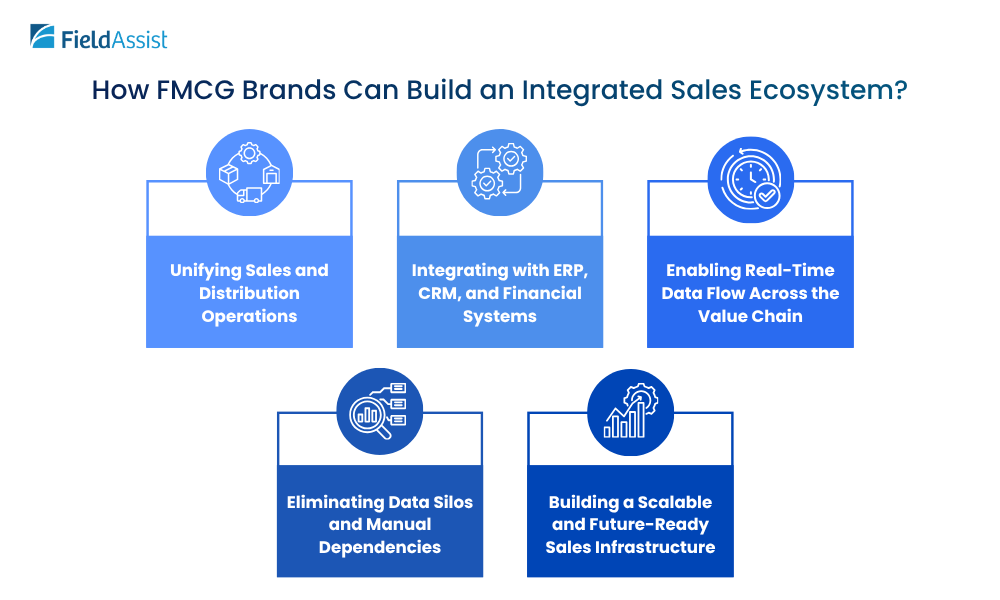
Building an integrated sales ecosystem is a strategic initiative, not a software procurement exercise. It requires a deliberate architecture that connects people, processes, and technology across the entire value chain. Platforms like FieldAssist are enabling this shift for leading FMCG brands by providing a unified SFA + DMS + Retail Execution infrastructure that serves as the integration backbone for sales and distribution operations. Here is how brands can approach this transformation:
1. Unifying Sales and Distribution Operations
When SFA and DMS operate on a shared data layer, field orders instantly reflect at the distributor level. This removes delays, reduces manual coordination, and ensures faster replenishment—leading to better service levels and fewer missed sales.
2. Integrating with ERP, CRM, and Financial Systems
Seamless integration with ERP software for FMCG industry, CRM, and financial systems ensures sales data flows across functions without gaps. This improves billing accuracy, inventory planning, and financial visibility, enabling brands to make more confident and timely decisions across their sales and distribution operations.
3. Enabling Real-Time Data Flow Across the Value Chain
Real-time data synchronization ensures that every order, outlet update, and promotion activity is instantly visible across teams. This allows brands to respond quickly to market changes, improve execution, and capture demand more effectively.
4. Eliminating Data Silos and Manual Dependencies
Replacing manual reporting and fragmented communication with automated data flows reduces errors, saves time, and improves overall operational efficiency—creating a more reliable and scalable system.
5. Building a Scalable and Future-Ready Sales Infrastructure
A connected, SaaS-based ecosystem enables brands to scale operations across regions and distributors without added complexity, while also preparing them for advanced capabilities like predictive analytics and automation.
How Platforms Like FieldAssist Enable Integration?
- Unified Ecosystem: SFA + DMS + Retail Execution
FieldAssist brings SFA, DMS, and retail execution into one platform, ensuring all stakeholders work on the same real-time data. This eliminates system silos, reduces manual effort, and improves overall sales coordination. For FMCG brands with large distributor networks, a unified ecosystem removes fragmentation, improving revenue and agility.
- Real-Time Data Sync
All activities - orders, outlet visits, and inventory updates are synced instantly across teams. This enables better visibility, faster decisions, and more proactive sales execution. This real-time data sync, powered by robust B2B integration software architecture, transforms reactive sales management into proactive, intelligence-driven execution.
- Scalable for Large FMCG Operations
Built as a cloud-based platform, FieldAssist is designed to scale with the brand — from regional players managing 50 distributors to national FMCG giants with multi-thousand distributor networks, cross-category portfolios, and pan-India or international footprints.
Business Impact: What FMCG Brands Gain
FMCG brands that adopt an integrated sales ecosystem consistently see measurable improvements in efficiency, visibility, and growth. By connecting field execution, distributor operations, and backend systems, they eliminate manual gaps, improve decision-making, and enable faster, more accurate execution across the value chain—driving higher sales conversion, better inventory control, and scalable expansion.
A strong example is Bonjour, which partnered with FieldAssist to unify its SFA, DMS, and backend systems into a seamless workflow. This integration enabled 100% process digitisation and barcode billing, a 150% increase in SFA adoption, and 2X growth in its distributor network—demonstrating how FieldAssist powers scalable, integrated FMCG operations.
Conclusion: From Systems to Ecosystems
FMCG growth in 2026 depends on connected execution, not isolated tools. Winning brands will unify sales and distribution into an agile, intelligent ecosystem powered by an enterprise integration platform. The cost of fragmentation is now measurable—lost revenue, lower field productivity, missed promotions, and weaker distributor trust. Operating with disconnected SFA, DMS, and retail systems creates a clear competitive disadvantage.
The path forward is simple: adopt a SaaS integration platform that connects your entire value chain, enables real-time intelligence, and eliminates manual gaps—before competitors move faster.




.avif)