Decoding Nigeria’s Open Market: Playbook for FMCG Growth
Nigeria emerges as the fastest-growing FMCG market, where 90% of retail sales are in Informal or traditional channels. FieldAssist showed the RTM strategy and technologies to tap the untapped market.

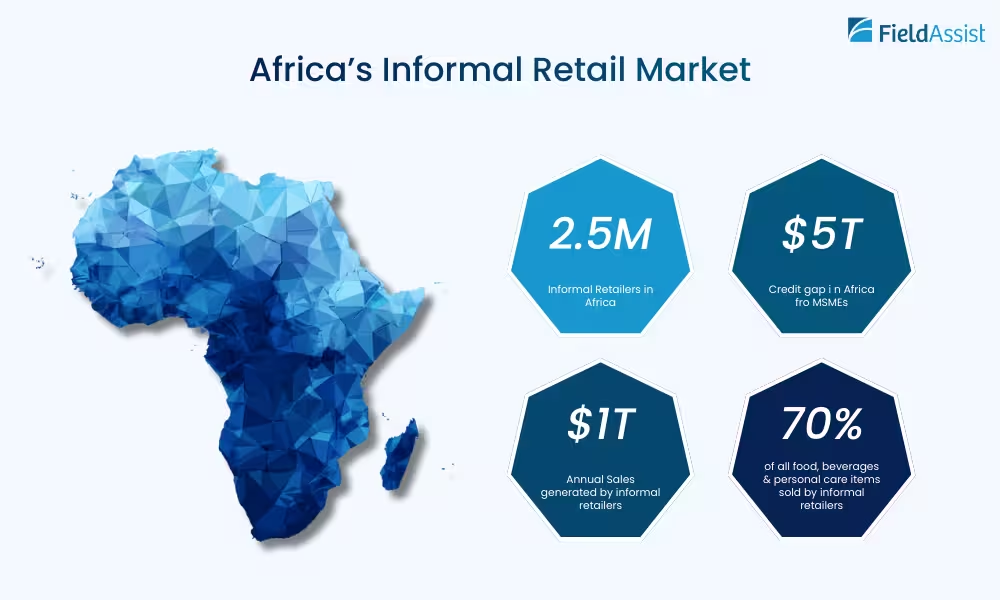
The overall FMCG Sector in Nigeria was valued at USD 30.53 billion. But do you know that Informal or traditional retail, which essentially is the Open Market, accounts for 90% of total retail sales value in Nigeria?
With as much as 90–95% of all retail transactions flowing through kiosks, hawkers, and open-air stalls, Nigeria’s open market is not just a retail channel; it is a living, breathing system where scale is earned one outlet, one interaction, and one execution cycle at a time.
Yet most FMCG businesses still approach it with legacy playbooks built for structured trade. The result is generally blind spots in demand, unpredictable coverage, and growth that depends more on intuition than intelligence.
The next wave of market leadership will belong to brands that treat the open market as an operating system - one that can be sensed, learned, optimized, and reinvented through data, field insight, and precise digital execution.
What is the Open Market in FMCG?
The Open Market is a highly fragmented, unorganized, and informal retail ecosystem that drives the bulk of consumer goods sales in emerging economies, especially in countries like Nigeria. It includes thousands of kiosks, dukka shops, petty traders, hawkers, open-air markets, and neighborhood retailers who sell fast-moving goods every day but operate entirely outside the structured borders of modern trade, supermarkets, or large organized chains.
In Nigeria, this ecosystem is not peripheral — it is the mainstream. The population base supporting this ecosystem is massive: Nigeria counts over 250 million people, making it Africa’s largest consumer market — underscoring the scale of demand that Open Market can tap.
The Pulse of Nigeria’s Open Market Operations: Traces You Can See, Hubs You Can’t Ignore
If you look closely at Nigeria’s open market, a quiet order begins to reveal itself. What appears unstructured at first glance is actually a living network shaped by movement, proximity, and the daily rhythms of the people it serves. When you step back and observe the flow of goods, the migration of traders, and the clustering of retail activity, you see a pattern that repeats across every major region: the open market has a pulse — and it leaves visible traces everywhere it operates.
Traces You Can See: Where Informal Retail Leaves Its Footprints
- Retail clusters along transport corridors where mobility drives micro-commerce.
- Dense retail belts around motor parks which act as daily commerce accelerators.
- Mini-markets embedded inside neighborhoods, reflecting hyperlocal demand.
- Secondary cities showing equal or higher informal activity compared to major metros.
Even Nigeria’s informal-economy profile reinforces this structure: nearly 44% of all informal businesses belong to retail and trade, and Lagos alone contributes 16% of the country’s informal market base — indicating how concentrated these traces are.
These aren’t random dots. They are demand signatures showing where Nigerians actually buy their daily essentials.
The Hubs You Can’t Ignore: Where Trade Converges and Scale Happens
When these traces are overlaid with wholesale movements, a second layer emerges i.e open-market hubs. These are commercial nodes where hundreds of micro-retailers, sub-wholesalers, and van sellers converge to replenish stock.
Markets such as Balogun and Idumota (Lagos), Singer Market (Kano), Onitsha Main Market, Wuse (Abuja), and Mile 1 & Mile 3 (Port Harcourt) act as the operational backbone of FMCG flow. Sector reviews suggest that a significant share of daily replenishment in their surrounding districts originates from these hubs, making them volume compressors for the regions they serve.
Although public reports rarely publish hub-level metrics, field practitioners consistently observe:
- Predictable demand cycles centered around hub restock days
- Category-based clustering (e.g., households in one zone, beverages in another)
- Price stability is driven by a few dominant wholesalers
- Rapid stock rotation compared to standalone retail pockets
In essence, hubs function as economic gravity centers - shaping what moves, how fast it moves, and who participates in the flow.
Why This Matters for FMCG Leaders?
Ignoring these traces and hubs leads to blind spots in coverage, distributor productivity, and SKU availability. But mapping them unlocks a new understanding of Nigeria’s retail landscape:
- Where beats must be redesigned
- Where van sales outperform manual ordering
- Where demand is concentrated but invisible
- Where pricing control originates
- Where brands lose market share without warning
The real pulse of Nigeria’s FMCG sector is not found in modern trade or quarterly reports. It beats inside these clusters, corridors, and hubs.
Leaders who can interpret these signals don’t just see the market; they understand how it moves.
Digitizing the Open Market– What’s the Route -to -Market (RTM) Plan?
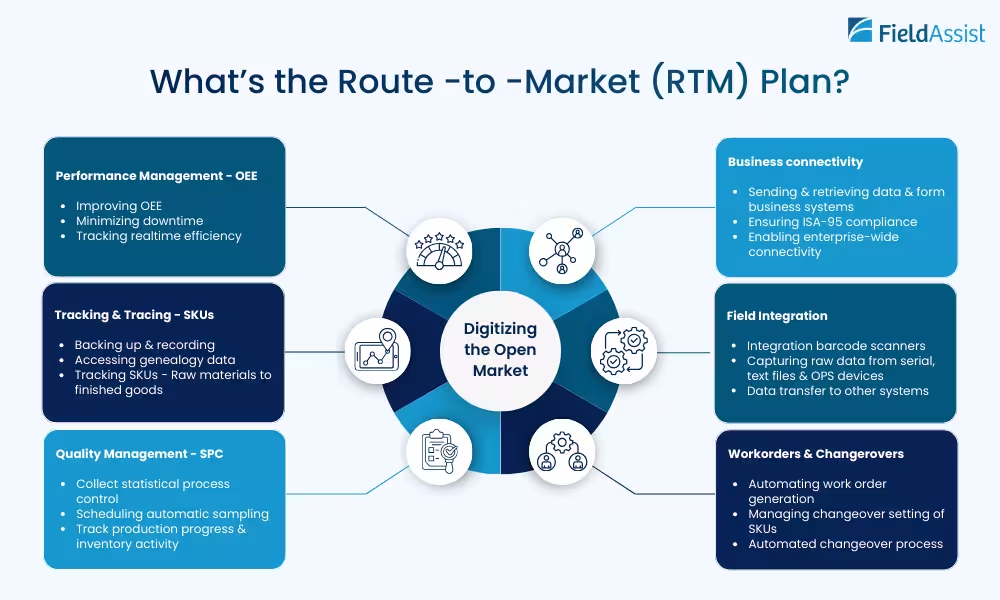
What was once considered as an intractable segment (thousands of small kiosks, petty traders, open-air markets) is now being viewed as a core opportunity for digital transformation.
This awakening arises from several converging trends such as fintech expansion, smartphone and internet penetration, B2B-platform innovation, and renewed urgency from brands and distributors to plug demand-visibility gaps.
Nevertheless, Nigeria’s push toward a digital economy — backed by policy and growing telecom/internet coverage — is creating a foundation for transformation.
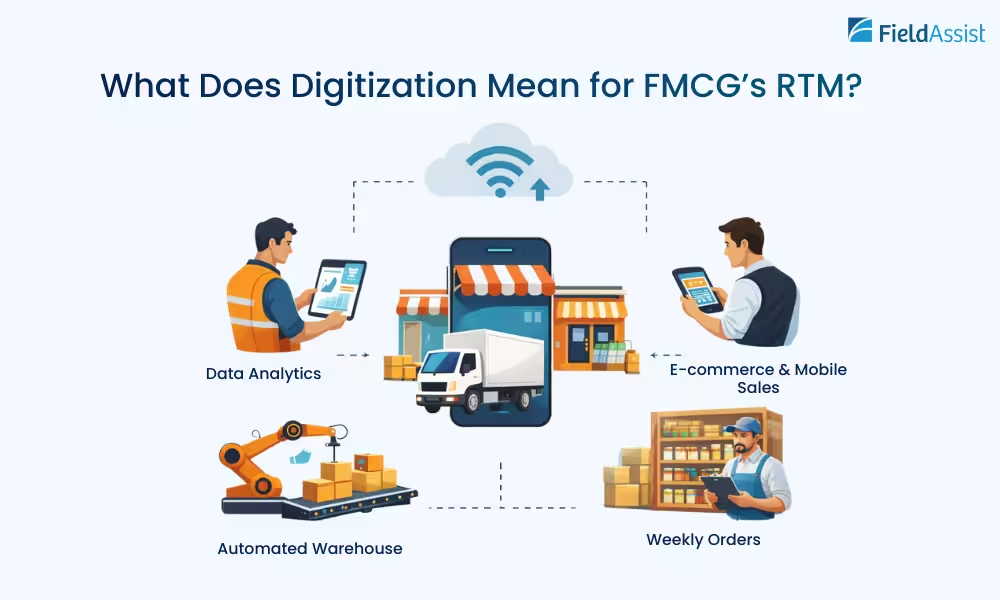
So, What Does Digitization Mean for FMCG’s RTM?
Digitization is no longer about “apps for ordering.” It is a complete rethinking of Route-to-Market (RTM) for a country where informal retail drives majority of FMCG transactions. To build a digital-ready RTM model for Nigeria, leaders need to focus on four structural shifts happening underneath the surface, and that is:
1. Mapping the Invisible Retail Universe
The first step in digitizing RTM is making the open market visible. AI-driven retail mapping and territory intelligence tools now help FMCG teams pinpoint where demand originates, how it propagates across neighborhoods, and which outlet clusters influence wholesale hubs.
Modern RTM design requires systems that can:
- Identify outlet clusters,
- Classify stores by potential,
- Infer weekly order cycles and,
- Detect micro-market demand patterns.
2. Digitizing the Distributor Engine
The second layer of RTM transformation is the distributor network. Digitally mature RTM models rely on platforms that provide:
- Real-time stock and pricing visibility,
- Automated replenishment signals,
- Scheme governance controls and,
- Structured order-to-cash flows.
When distributor systems sync with field execution tools, every invoice, visit, and return becomes a data signal — reducing guesswork, improving compliance, and creating a closed-loop view of supply and demand.
3. Integrating Wholesale Hubs Into Execution Intelligence
Nigeria’s wholesale hubs - Balogun, Idumota, Onitsha Main Market, Singer Market, Mile 1, Mile 3 - act as volume amplifiers for surrounding micro-markets. They cannot remain offline in a digital RTM plan.
Tech-led RTM systems now allow brands to:
- Capture hub-level order patterns,
- Monitor bulk movement of high-velocity SKUs,
- Model pricing stability and,
- Sense early shifts in category demand.
This hub intelligence allows managers to redesign van routes, adjust distributor allocations, and prevent leakage before it reaches retail shelves.
4. Elevating From Execution to Prediction
The most advanced RTM models layer decision intelligence over traditional digitization. Using unified data from field visits, distributor systems, retailer orders, and hub-level flows, brands can now generate predictive signals on:
- Territory saturation,
- Impending sales dips,
- Out-of-stock probabilities,
- Coverage fatigue and,
- Emerging micro-market opportunities.
This transforms the RTM model from reactive coverage to anticipatory execution.
How Automation Transforms Open-Market Execution?
Automation is becoming essential for managing Nigeria’s open market. In a channel where decisions depend heavily on manual effort, paper-based routines, and inconsistent field execution, automation brings speed, accuracy, and control at scale. It helps FMCG leaders run the open market like a measurable system rather than a fragmented network. One such example is Blume Nigeria,
Here is how automation strengthens RTM execution:
1. Stronger Field Execution
Automated SFA systems give sales reps a structured way to work in the open market. They help by tracking every outlet visit, recording orders instantly, capturing availability and visibility issues, and guiding reps with nudges or next-best-actions. And the result is, better beat compliance, higher strike rates, and more reliable demand visibility.
2. Distributor Control and Supply-Chain Stability
A digitized DMS connects inventory, pricing, schemes, and order flow in real time. It enables accurate stock monitoring, automated order approvals, tighter control on discounts and schemes, and syncing distributor data with field execution tools.
3. Intelligent Route Planning
AI-driven route planning studies outlet clusters, travel patterns, past performance, and demand cycles. It builds dynamic routes instead of fixed weekly routines, ensuring more productive routes, better coverage of high-value clusters, and reduced travel wastage.
4. Cleaner Scheme and Pricing Control
Automation ensures that schemes reach only eligible retailers and pricing remains consistent. It helps brands to minimize fraud, detect deviations early, monitor POSM and schemes with data trails. Thus, ensuring stronger financial governance and better ROI on trade spends.
5. Rural Automation into Hard-to-Cover Markets
Automation enables visibility and execution in rural and peri-urban pockets where traditional RTM struggles. It supports digital ordering for remote outlets, van-sales automation for cash-and-carry markets, and monitoring of rural beat performance. The result is higher rural penetration, more frequent coverage, and reduced dependency on manual processes.
The Open Market is Changing, and FieldAssist is Showing What’s Possible
Nigeria’s open market is entering a new phase, and their FMCG industry is now becoming a digitally enabled ecosystem where demand can be sensed, territories can be redesigned, and execution can be governed with far greater precision. The shift is not theoretical - it is already unfolding on the ground.
A clear example comes from Blume Nigeria, where digitizing routes, distributor operations, and field execution created a unified view of the open market.
The question for FMCG leaders is no longer “Should we digitize the open market?” but “What does a working model actually look like?”
What made the difference was not software alone, but a completely different OS rhythm, where every aspect of sales and distribution were mapped and prioritized using real-time intelligence.
To know more about FieldAssist suites and RTM changing the course of Nigeria’s Open Market, feel free to contact us.